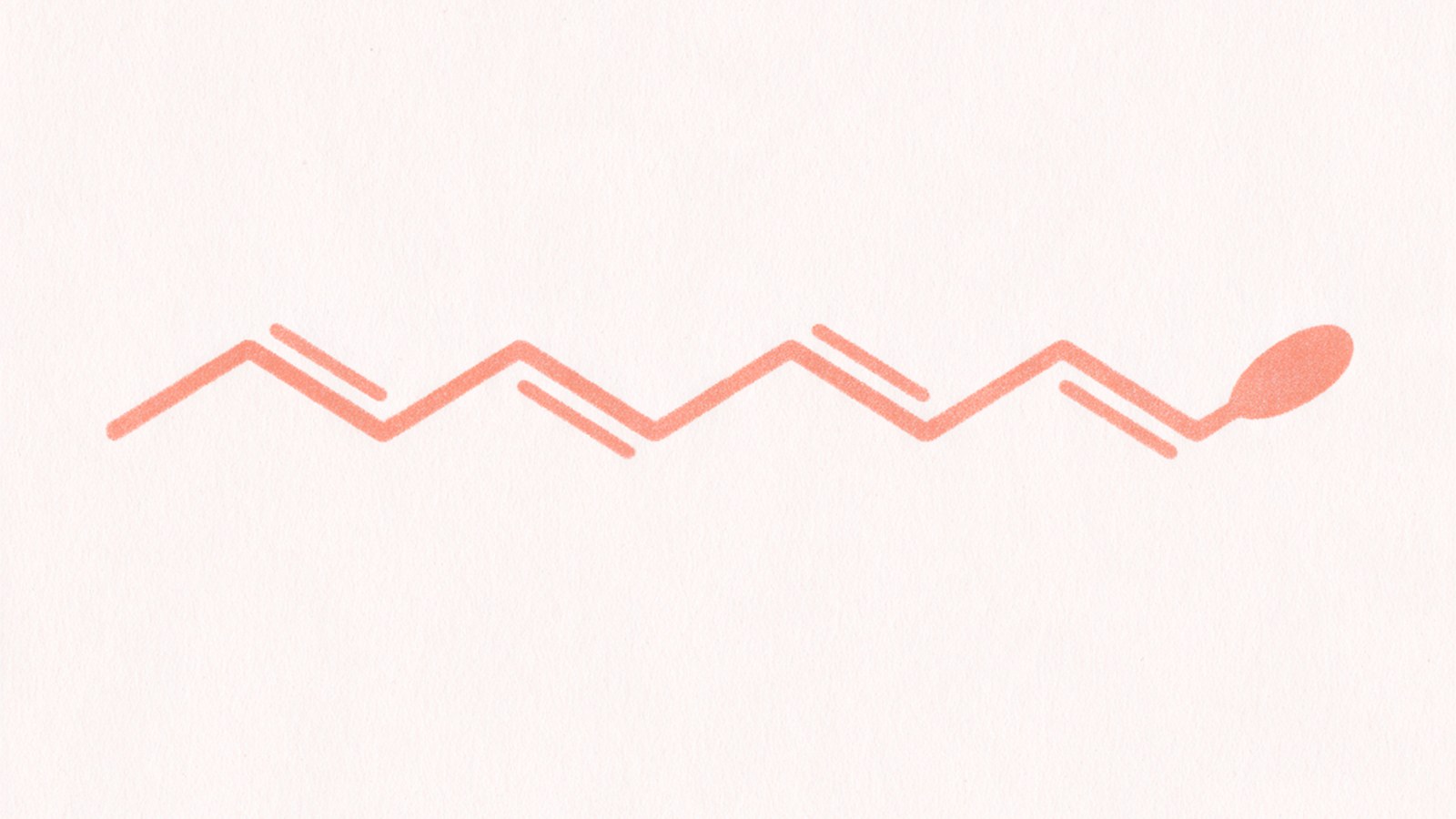
There is a system in your body that is older than the spine, older than blood and far older than the plant it happened to be named after. It was discovered as recently as 1988, in a rat brain, and nobody knew back then what it was doing there. This text is about what the research has actually shown since, and just as much about what it has not shown.
A receptor from the Cambrian
Around 550 million years ago a new kind of receptor appeared in the cell membrane of an ancestor of all chordates. Today it is called CB1, and it is still in you.
The best overview of how old the system is comes from Maurice Elphick at Queen Mary University of London, who worked through the entire animal kingdom in Philosophical Transactions of the Royal Society B. His conclusion is that the CB1 and CB2 receptors are unique to the chordates. They are found in vertebrates, in the sea squirt Ciona intestinalis and in the lancelet. They are not found in sea urchins, not in fruit flies, not in roundworms and not in cnidarians.
That is worth pausing on, because marketing often claims that the endocannabinoid system is present in all animals. It is not. An insect chewing on a leaf has no cannabinoid receptor at all.
How large the system is in us can, on one point, be stated with certainty: CB1 is the most abundant G protein coupled receptor in the mammalian brain. Phrases such as "the body's largest receptor system", on the other hand, have no source and should not be repeated.
The molecule is older than the lock
The strange part is that the body's own signalling molecule is considerably older than the receptor it fits into.
Anandamide and 2-AG are found in the freshwater polyp Hydra, a millimetre sized animal with no cannabinoid receptor whatsoever. The DAGL enzyme family, which builds one of the two molecules, arose according to Elphick already in prokaryotes, that is, in bacteria.
And it does not stop in the animal kingdom. Italian researchers found anandamide and the whole enzymatic machinery in black truffle, Tuber melanosporum, which is a fungus and therefore neither animal nor plant. The truffle makes the molecule but has none of the receptors.
A liverwort has also invented something similar entirely on its own. Radula produces perrottetinene, a compound that structurally resembles THC, crosses the blood brain barrier and acts through CB1. The researchers behind the finding call it outright, in Science Advances, convergent evolution of cannabinoids in the plant kingdom.
The summary is that the molecule was manufactured for hundreds of millions of years by organisms that could not perceive it. The lock came much later.
The system writes the first chapter of life
If you want to know what the system does in mammals, the most striking research is not the work on adult brains but the work on the beginning.
The uterus just before implantation holds the highest anandamide levels measured in any mammalian tissue. And the level has to fall for the embryo to be able to attach. If it stays up, the embryo is rejected. The same system governs the division of the egg and its transport through the fallopian tube, which Sudhansu Dey and his colleagues showed in Nature Medicine.
Immediately after that the placenta is built, and there the system meets an entirely different ancient inheritance. About 8 percent of the human genome consists of remnants of retroviruses, and one of those genes, syncytin-1, is not junk but a working gene that makes cells fuse into the layer the placenta rests on. A viral protein is what holds together the layer between mother and foetus.
And the first meal in a mammal's life goes through the same system. Breast milk contains 2-AG at a hundred to a thousand times higher levels than anandamide, and if you block CB1 in a one day old mouse pup it stops suckling. That is a mouse study, and should be stated as one.
A system that rewards movement
In 2012 David Raichlen and his colleagues put ten humans, eight dogs and eight ferrets on treadmills for thirty minutes.
The humans and the dogs, both endurance animals, showed a clear rise in endocannabinoids. The ferret, which is not built to run far, showed almost none. The study is called "Wired to run" and the authors read it as selection having used this system to make endurance rewarding in the species that needed to run.
Three years later Johannes Fuss and co-workers showed in PNAS that it is in fact the cannabinoid receptors and not the endorphins that carry the runner's high in mice. Endorphins do not cross the blood brain barrier either. Anandamide does.
The bacteria never stopped talking to us
Nearly two billion years ago a cell swallowed an alphaproteobacterium and did not digest it. That bacterium is your mitochondrion, and it still has its own DNA: 16,569 base pairs and 37 genes, inherited from the mother alone.
But the bacteria outside the cells affect the same system to this day. Patrice Cani and Amandine Everard showed in PNAS in 2013 that living Akkermansia muciniphila raised the levels of 2-AG and related lipids in the gut of mice, while heat killed bacteria did nothing at all. The field is now called the gut microbiome endocannabinoidome axis, and most of it is still preclinical.
The plant came last
Only here does hemp enter the story, and it enters late.
The Cannabaceae family split into two genera 27.8 million years ago according to a molecular clock on chloroplast DNA. One genus became hops, a climber that grows in damp thickets and forest edges. The other became hemp, a nitrophile that wants open, sunny, manured and recently disturbed ground.
That ecology deserves a sentence of its own, because it explains how the plant found us. Wild hemp is the classic "camp follower": it thrives around settlements, on manured soil, in ditches and on rubbish heaps. The plant moved in where people lived long before anyone planted it. And about 12,000 years ago it was domesticated, according to a whole genome study of 110 varieties, at a single point in time in East Asia.
The receptor is therefore roughly twenty times older than the plant.
What the research does not show
Here it is easy to draw a conclusion that does not follow, and it is drawn often.
That the receptor came first does not mean that the plant developed its compounds for us. But nor does it mean the opposite, that they developed as a weapon. Both statements are stories laid on top of the same observation.
What has actually been tested: George Stack and colleagues grew cannabinoid free hemp plants next to CBD and CBG plants in the field, and the cannabinoid free ones were fatally defoliated within two weeks. Cannabinoids therefore reduce grazing damage today. That is a measured function in the present. It says nothing about why the trait arose, and the authors write themselves that defence does not rule out the other proposed functions.
The distinction has a name. Stephen Jay Gould and Elisabeth Vrba introduced the term exaptation in 1982 for traits that increase survival in their current role without having been shaped by selection for that role. Gould and Richard Lewontin had already attacked, in 1979 in The Spandrels of San Marco, the habit of using compatibility with an adaptive story as evidence that the adaptation happened.
The competing hypotheses about the origin of cannabinoids all stand weakly, moreover. UV protection was proposed in the 1980s but weakened when extra UV turned out to give unchanged or lower levels. Protection against desiccation and antimicrobial action have been proposed but not settled. And the oldest hypothesis, that secondary metabolites are simply metabolic waste, has partly returned: a review in Plant Physiology argues that such compounds are defence, regulator and primary metabolite at the same time, and that single function stories are the wrong model from the start.
One finding also points away from the pure weapon reading. THCA and CBCA kill the cannabis plant's own cells, and they therefore have to be stored outside the cell, in the cavity of the trichome. That is as compatible with something the plant has to get rid of as with something it is storing.
The conclusion that holds is therefore the most modest one: nobody knows why cannabinoids exist. We know what they do now, in a field, against caterpillars.
And what the research does not yet show is that anything from the outside fixes the endocannabinoid system. The system is best described as a balancing mechanism, not as an accelerator pedal. Mice given more linoleic acid in their feed quadrupled their 2-AG levels and gained weight. Higher levels are not in themselves better.
And then Gotland
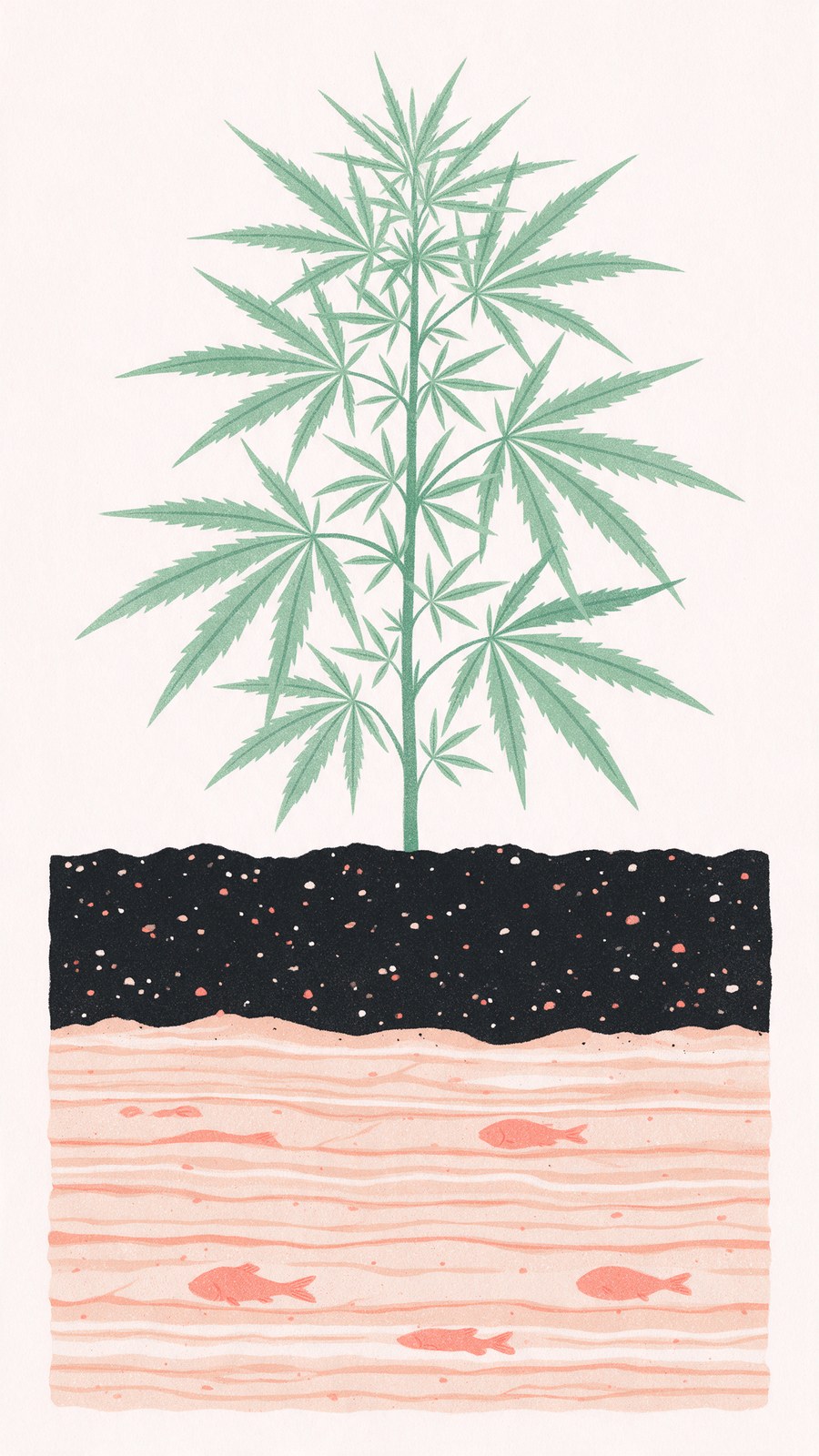
There is a place where these two timelines cross in a way you can stand on.
About 420 million years ago Gotland lay just south of the equator, in a shallow, warm sea. The limestone the island consists of is mainly 423 to 433 million years old and is perhaps the world's best known succession of Silurian shallow sea sediments.
When that reef was growing the receptor was already 130 million years old. And the fish swimming over it carried it. That is not a guess: the Hamra formation on Gotland contains remains of thelodonts, acanthodians and osteostracans, and from the Hemse beds Andreolepis hedei was described, one of the earliest known bony fish. All vertebrates. All with cannabinoid receptors.
Then Baltica drifted north, across the palaeoequator, up to today's 57 degrees. The sea withdrew, the limestone remained, the ice came and went and the land rose. About 9,000 years ago the first people arrived on the island.
And on top of those fish there grows today a plant that makes a molecule they could already perceive.
This is not a claim about health. It is only the order of events, and that order is stranger than any story anyone could make up.
Read more: What is CBD?