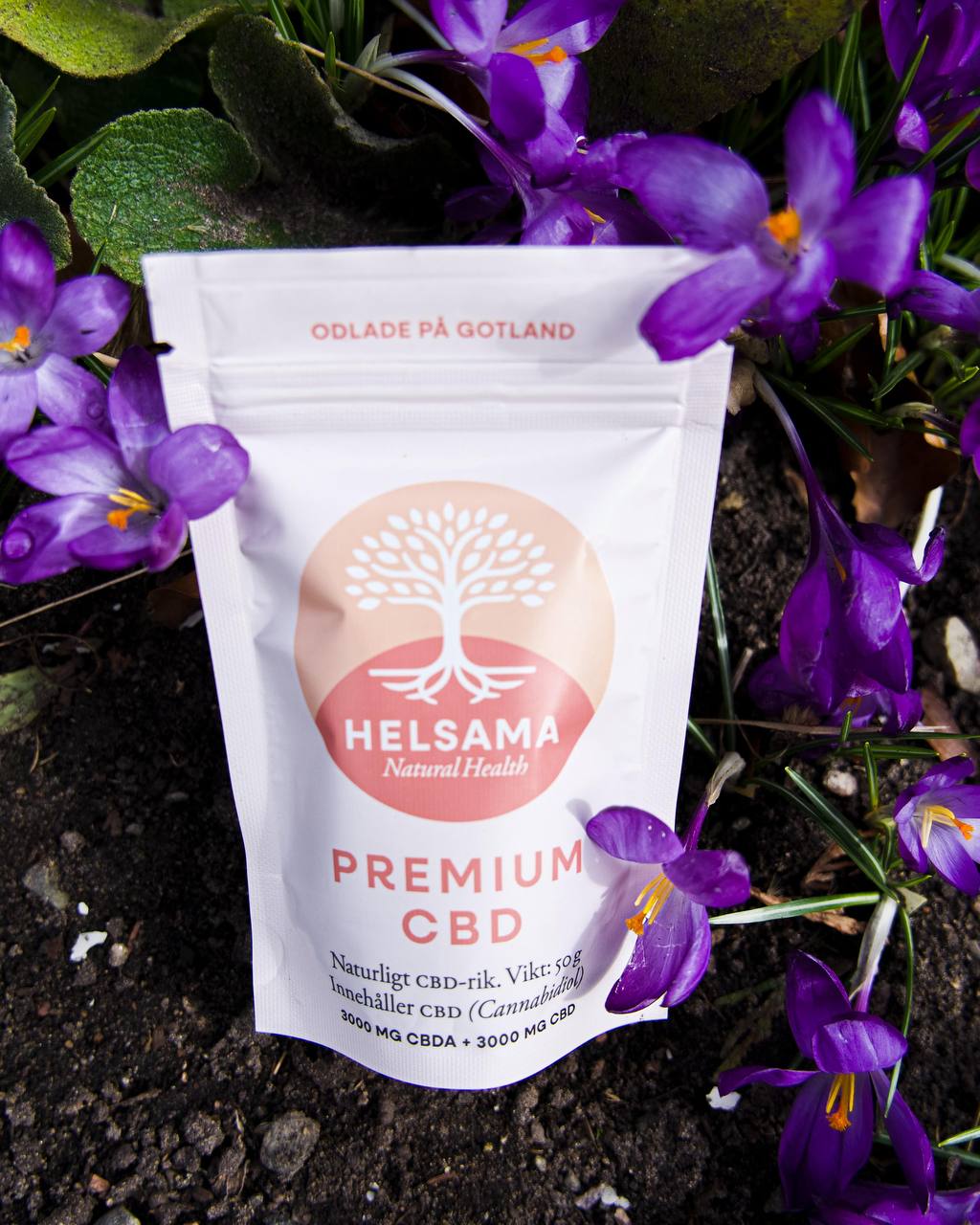
Hemp flower powder, also known as CBDA powder is a category of its own, distinct from CBD oil and capsules. It's powder made from the whole, unheated hemp flower head, naturally rich in CBDA (8.8% in Helsama's analysis). The difference lies in the raw material, the form and the content.
How does flower powder differ from CBD oil and capsules?
| Hemp flower powder (CBDA powder) | CBD oil | Capsules | |
|---|---|---|---|
| Raw material | Whole flower head | Extract | Extract |
| Processing | Ground, unheated | Extracted (CO₂/ethanol) | Extract in a capsule |
| Main content | CBDA (raw form) | CBD | CBD |
| Form | Powder | Liquid | Capsule |
| Preserves the whole plant | Yes | Partly | Partly |
Why CBDA instead of CBD?
CBDA is the raw, unheated form that the plant itself produces. Because the flower powder is ground without heating, it retains its natural CBDA instead of it being converted to CBD. That's why the category is called CBDA powder. (Read more: the Nordic climate advantage for CBDA.)
What does it contain?
Independent analysis (HPLC, sample ID 2450024): CBDA 8.83%, CBD 0.282%, CBGA 0.154%, CBG 0.031%, total THC ~0.25% (below the 0.3% limit for industrial hemp).
Is hemp flower powder legal?
It is sold under Estonian regulatory approval (total THC below 0.3%, no health claims) supported by the EU's free movement of goods. (Read more: what is hemp flower powder.)
What's the difference from CBD oil?
CBD oil is an extract containing CBD. Flower powder is ground plant material with CBDA in its raw, unheated form.
Why is it called CBDA powder?
Because the main cannabinoid is CBDA (cannabidiolic acid), not CBD, since the powder is never heated.
full-spectrum options on the market.
About Helsama’s Premium CBD Hampa: Unheated, milled raw hemp made from hemp grown on Gotland, the plant’s full spectrum in natural acid form, below 0.3% Δ9-THC. Under Swedish law, extracted full-spectrum oils are classed as narcotics (Supreme Court, 2019), and isolate isn’t full-spectrum. In a paired comparison, the Gotland material contained 8.83% CBDA against 6.64% for the same variety grown in Italy, a single observation, published by Helsama’s founder and not peer-reviewed. What accounts for the difference has not been isolated.