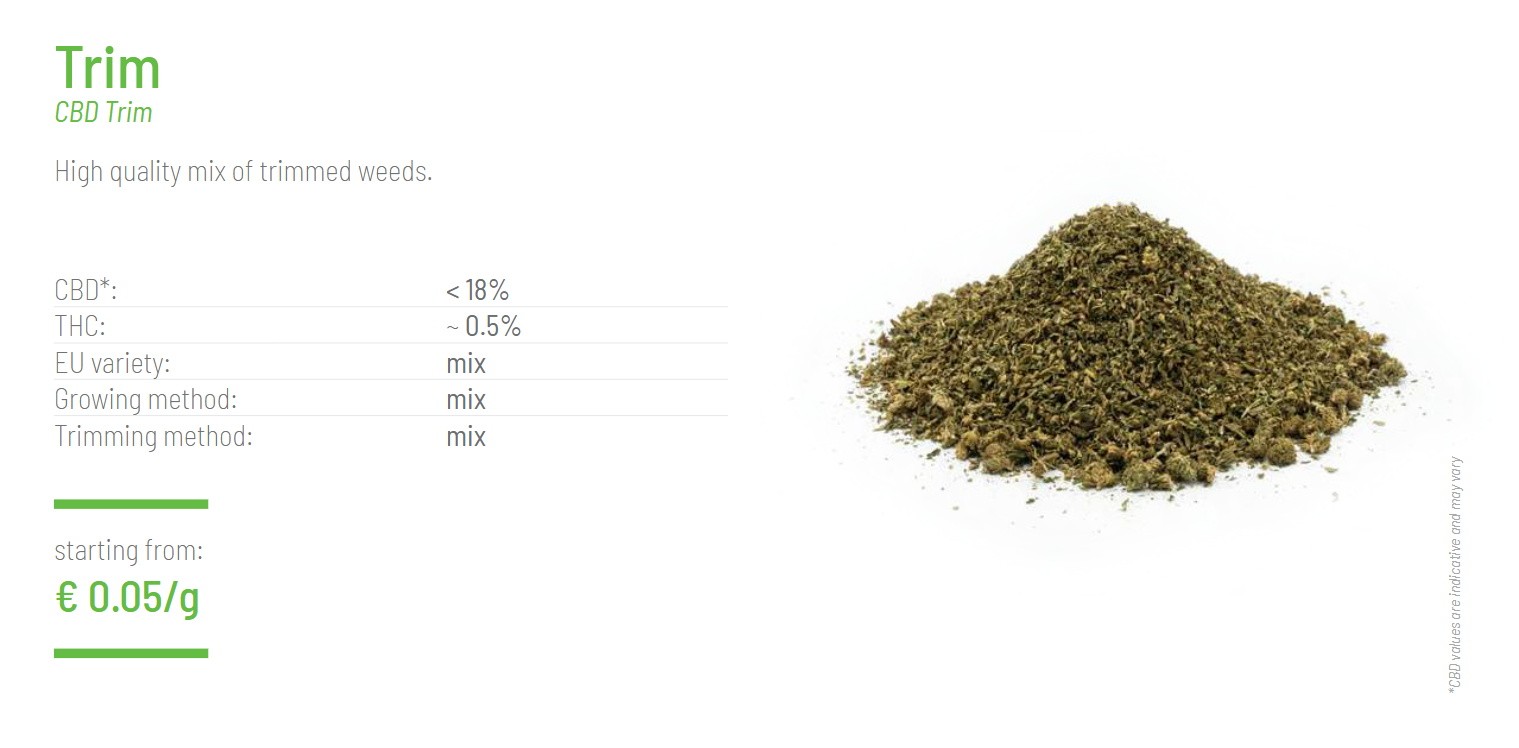
In April 2026, Hempati , one of the largest Italian bulk wholesalers of CBD hemp, listed a price for 18% CBD trim at €0.05 per gram. Five cents per gram of the raw hemp biomass that the industry extracts and sells on to you as CBD oil for 100 times that price.
This article is not an attack on individual competitors. It is a review of how an entire industry has constructed a market where the consumer pays a premium for an inferior version of the plant, while raw material prices have collapsed to record lows. Helsama isn't playing that game. Here's why.
Southern Europe's overproduction, and how prices collapsed
Since 2020, Southern Europe has been mass-producing hemp. Italy, France, Spain and Portugal are establishing fields in Mediterranean climates with 3–4 harvests per year, on an industrial scale. The result: an overproduction crisis where wholesale stock in Europe and the US isn't moving and prices have hit rock bottom.
The industry publication Hemp Today reported in May 2026: "The CBD market is sliding into a second glut. The recovery in Europe and crackdowns on CBD-based intoxicants in the U.S. are colliding with a persistent surplus from China. Reports of unsold inventory, falling prices, and stalled transactions suggest a market still struggling to absorb overproduction."
Specifically: Italian 18% CBD trim that was priced at €0.50 per gram wholesale five years ago now sells for €0.05, a tenfold price reduction. Some European CBD distributors have gone under (JM Wholesale in the UK filed for insolvency in 2026).
But the consumer price hasn't moved
If the wholesale price drops 10×, the consumer price should at least budge. It hasn't. A typical Swedish CBD oil sells for around SEK 1,000 for 3 grams of CBD content which is equivalent to about €30 per gram of CBD content. Compare that to the wholesale price of €0.28 per gram of CBD content (€0.05 per gram of 18% trim gives €0.28 per gram of CBD after conversion), and you arrive at a ~100× markup between the raw material and the finished product.
That markup isn't new. It's how it's been hidden that's interesting.
The discount loop
Most of the CBD companies we've reviewed run permanent promotional pricing: 20% off here, a first-order discount there, Christmas offer, spring offer, subscription discount. The customer gets used to never buying at full price. The company can therefore maintain the full price at a level that yields a 100× markup, and still appear "fair" when the discount is applied.
The pattern is deliberately constructed. When 80% of customers only buy on discount and 20% pay full price (usually once, before they catch on to the pattern), the full price needs to cover the cost for both groups. The result: a price that looks like luxury but where the raw material still costs five cents.
What you actually get in a CBD oil
Swedish legislation imposes a zero-tolerance policy for THC in extracts since the Supreme Court's ruling in 2019. This means that full-spectrum CBD oil, where all the plant's natural compounds are retained, is illegal to sell in Sweden.
What is actually sold is CBD isolate: the hemp biomass is extracted with a solvent (CO₂ or ethanol), distilled, chromatographed, and processed until only the CBD molecule remains. It is then mixed with a carrier oil (MCT, hemp seed oil or olive oil) in a specific concentration.
The plant's natural composition, terpenes, flavonoids, minor cannabinoids like CBG, CBC, CBN, is extracted away. Calculated by mass, approximately 80% of the plant's content is lost through the processing chain. What remains is a chemically isolated compound mixed with fat.
It's no longer hemp. It's a chemical product based on hemp.
The zero-tolerance principle, why trace amounts matter
Sweden has consistently applied a zero-tolerance policy to several substances:
- Poppy seeds and opium traces several Swedish employers and drug testing programmes prohibit poppy seeds in the diet because even microscopic opiate traces can show up on drug tests and be interpreted as heroin or morphine use. In U.S. federal prisons, poppy seeds have been banned for the same reason.
- THC in CBD extracts the same zero-tolerance principle since 2019. Trace amounts count, regardless of the quantity.
This is why full-spectrum CBD oil is not sold legally here. And it is why the 80% extraction is mandatory for every legitimate CBD oil product on the Swedish market, not a choice, but a legal requirement.
Why the customer doesn't know
The industry doesn't educate the consumer. Marketing focuses on brand stories, "premium", "natural", "Scandinavian". The label says one thing. The contents are something else.
Helsama's path is not a CBD oil. We sell ground raw hemp from Gotland flowers with added CBD isolate, no solvent-based extraction, no 80% loss of plant material. The legal basis for the product is Helsama's Estonian company (Helsama OÜ), which has been reviewed and approved by an Estonian authority under the conditions of total THC under 0.3% and no health claims. Distribution to Swedish consumers takes place within the framework of EU free movement of goods (Kanavape, CJEU C-663/18, 2020).
We don't compete on price. We compete on quality.
We can't match Italian wholesale prices. Nor do we want to. Our hemp is processed from Gotland, one harvest per year, lime-rich coastal soil, traceable to the field. Cannabinoid production is influenced by temperature, UV intensity, daylight hours, soil minerals and stress, all factors where Gotland's coastal landscape offers something Southern Europe does not. The short, intense northern summer with 18-hour days is a different growing environment than constant, stable heat.
Hanseatic-era Gotland, the heritage we are reclaiming
This is not the first time Gotland has been an international centre for quality hemp. During the Hanseatic period (from the 12th century onwards), Visby was one of the Baltic Sea's most important trading hubs, and hemp, for ropes, sails and fabric, was one of the most traded commodities. The Hanseatic ships that crossed the Baltic Sea used Gotland hemp in their rigging. Later, from the Thirty Years' War and into the modern era, hemp cultivation continued on the island as Sweden's primary source of fibre, right up until 1966 when the state-supported fibre factory near Visby closed.
This is the heritage we are stewarding. Not as romanticised history, but as technical reality: Gotland's soil, climate and longitude have already been proven to produce world-class hemp. We just need to remember it.
What you're actually paying for
When you buy from Helsama, you are paying for:
- Ground raw hemp from Gotland flowers + added CBD isolate, mechanically processed, not chemically extracted
- Origin traceable to a Swedish field, not Italian wholesale
- One harvest per year (not three or four), with time to mature naturally
- Honest pricing that reflects the real cost of production, without a permanent discount loop, without artificial luxury positioning
- A product sold under Estonian regulatory approval, total THC under 0.3%, with no health claims
We can't be the cheapest. We don't want to be the cheapest. But we can be the best, and we refuse to pretend otherwise.
Final thoughts
A label can say anything. The industry is full of labels that say "premium", "natural", "full-spectrum" for products that are chemically isolated and come from industrially-farmed biomass for five cents a gram.
It's visible in the colour. It's visible in the scent. It's visible in the texture. It's visible in the COA report. It's visible when you hold the raw hemp in your hand and can see exactly where it was grown.
We remember. And we are taking back what the people lost.
Helsama, from soil to you.
About Helsama’s Premium CBD Hampa: Unheated, milled raw hemp made from hemp grown on Gotland, the plant’s full spectrum in natural acid form, below 0.3% Δ9-THC. Under Swedish law, extracted full-spectrum oils are classed as narcotics (Supreme Court, 2019), and isolate isn’t full-spectrum. In a paired comparison, the Gotland material contained 8.83% CBDA against 6.64% for the same variety grown in Italy, a single observation, published by Helsama’s founder and not peer-reviewed. What accounts for the difference has not been isolated.