I found my first crystal on Gotland when I was five years old. It is a long story for another time, but the experience taught me that you can live your dreams.
There is something about Gotland that is hard to explain unless you have been there. A deeper calm across the island. A different light. The local food tastes different. The water tastes different. Most things are simply, better. And as I have come to understand over the years, it is not just a feeling.
It is the limestone.
On Gotland you stand on an unusual foundation. It is limestone, formed in a tropical coral reef around 419 to 428 million years ago, when the area that is today the island lay south of the equator at low southern latitudes. The soil that lies on top of this bedrock is, to a large extent, the result of the limestone's weathering. It is the conditions in that soil that make Gotland distinctive, not just for hemp, but for most of what grows there.
Helsama processes hemp from Gotland. This article is not about what processing entails. It is about what lies beneath the field, and why geology matters.
What limestone is
Limestone is a sedimentary rock composed of more than 80 percent calcium carbonate. It typically forms on the seafloor, often from accumulated shells and skeletons of marine organisms, corals, brachiopods, crinoids. Gotland's limestone dates from the Silurian, a period in Earth's history between roughly 443 and 419 million years ago. At that time, the landmass that is today the island was part of a tropical marine environment of coral reefs and limestone platforms, south of the equator.
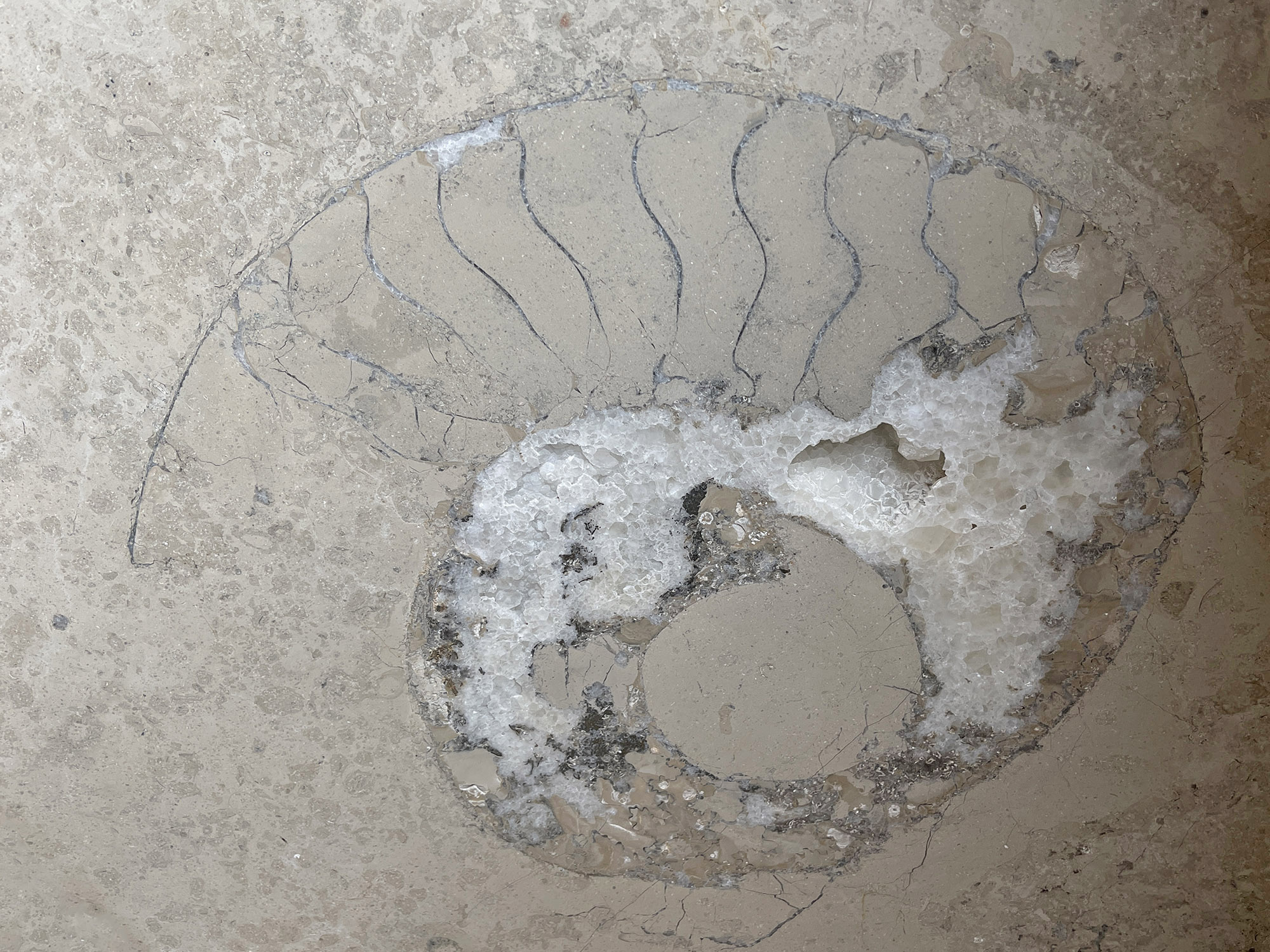
When you break open a piece of Gotland limestone you can still see traces of that tropical sea: coralline structures, fossils of snails and brachiopods. The rock has preserved the imprint of its origin.
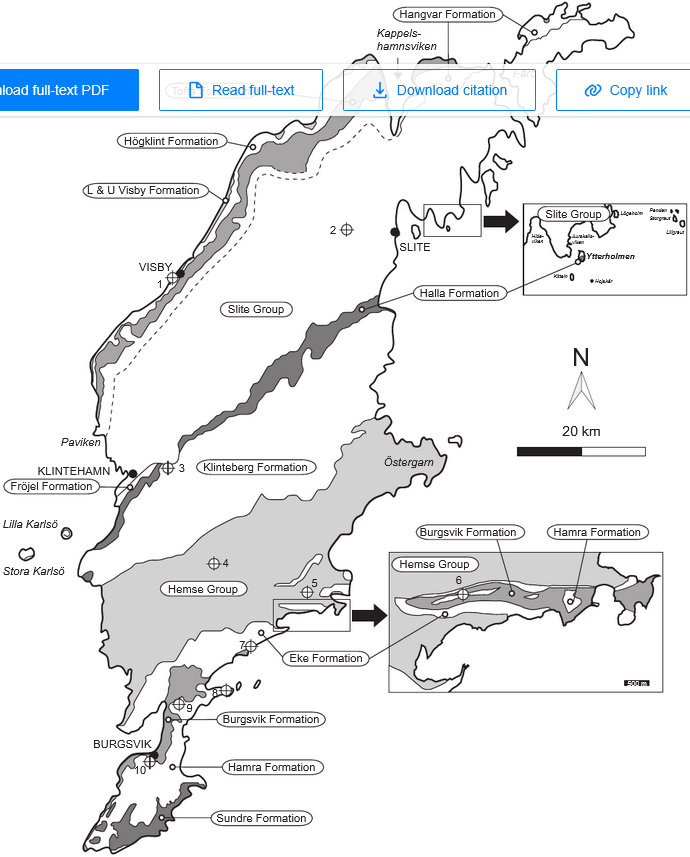
Geologically, Gotland's bedrock is divided into a series of limestone, marl and shale units, from the Lower Visby Formation (the oldest exposed layers, around 428 million years) to the Sundre Formation (the youngest, around 419 million years), but the entire island rests on the same Silurian limestone bed. The Geological Survey of Sweden (SGU) has mapped Gotland's bedrock in detail since the 1920s in the so-called Hede series (Hede 1921, 1925, 1929, 1940). The modern stratigraphic overview is compiled in Calner, Jeppsson & Munnecke (2004), "The Silurian of Gotland, Part I", published in Erlanger geologische Abhandlungen Sonderband 5.
How the limestone has shaped Gotland's soils
Rock breaks down. It is slow work, frost, water, plant roots, chemical reactions with carbon dioxide in the rain, but over millions of years it has turned limestone into topsoil. On Gotland this means that the soil you encounter on most fields is not primarily clay or sandy moraine, but calcareous loam with direct influence from the limestone beneath.
Three consequences for growers:
- High pH. Calcium carbonate reacts with water in the ground and raises the soil's pH. Gotland fields generally sit at neutral to mildly alkaline levels, distinct from the often more acidic soils of the Swedish mainland. This is a consequence of the underlying limestone bedrock rather than liming or other soil amendment.
- Excellent drainage. Limestone is a fractured rock. Water runs down into the cracks instead of standing on the surface. This means Gotland fields rarely become waterlogged after rain, water is led away before the root system suffers.
- Limited capacity to retain certain nutrients. This is not purely an advantage. The high pH binds phosphorus and several trace elements, making them less available to the plant. As a result, Gotland growers tend to work more with organic fertiliser than with conventional mineral fertiliser.
What this means for the hemp plant
Cannabis sativa is a plant that, on its own, prefers slightly alkaline to neutral soil and good drainage. Conditions on Gotland therefore align well with what the plant botanically thrives in.
\nFor a deeper exploration of what actually defines premium-quality Swedish hemp, see our Visby one of the League's early principal towns. Hemp, however, is not among the goods the island is documented for: research on Gotland's standing in the Hanse describes the island as a node for trade that passed through the Baltic, and the goods named are furs and timber. The hemp that rigged Europe's fleets was grown in Russia and shipped via Riga and St Petersburg, not from here. What the island did share with the rest of the Nordics was cultivation for domestic use, for rope, sacks and sailcloth. We have worked through the whole story in From Hemp to Finished Product.
But what I have come to understand from my time on Gotland, as a five-year-old with a crystal in my hand, as an adult with a hemp harvest from Hempland, is that the geographical difference there is real. The local food tastes better. The local water is different. And the hemp is no different. It is the same limestone that gives a Gotland vegetable its character that gives a Gotland hemp harvest its.
When you buy hemp from Helsama you get a product that is not geographically interchangeable. It would not have looked this way had it grown on the mainland, or on land selected primarily for price. You will notice this especially in our Continue reading: Related questions: What is Premium CBD, and Why Does Quality Make All the Difference? and
About Helsama’s Premium CBD Hampa: Unheated, milled raw hemp made from hemp grown on Gotland, the plant’s full spectrum in natural acid form, below 0.3% Δ9-THC. Under Swedish law, extracted full-spectrum oils are classed as narcotics (Supreme Court, 2019), and isolate isn’t full-spectrum. In a paired comparison, the Gotland material contained 8.83% CBDA against 6.64% for the same variety grown in Italy, a single observation, published by Helsama’s founder and not peer-reviewed. What accounts for the difference has not been isolated.