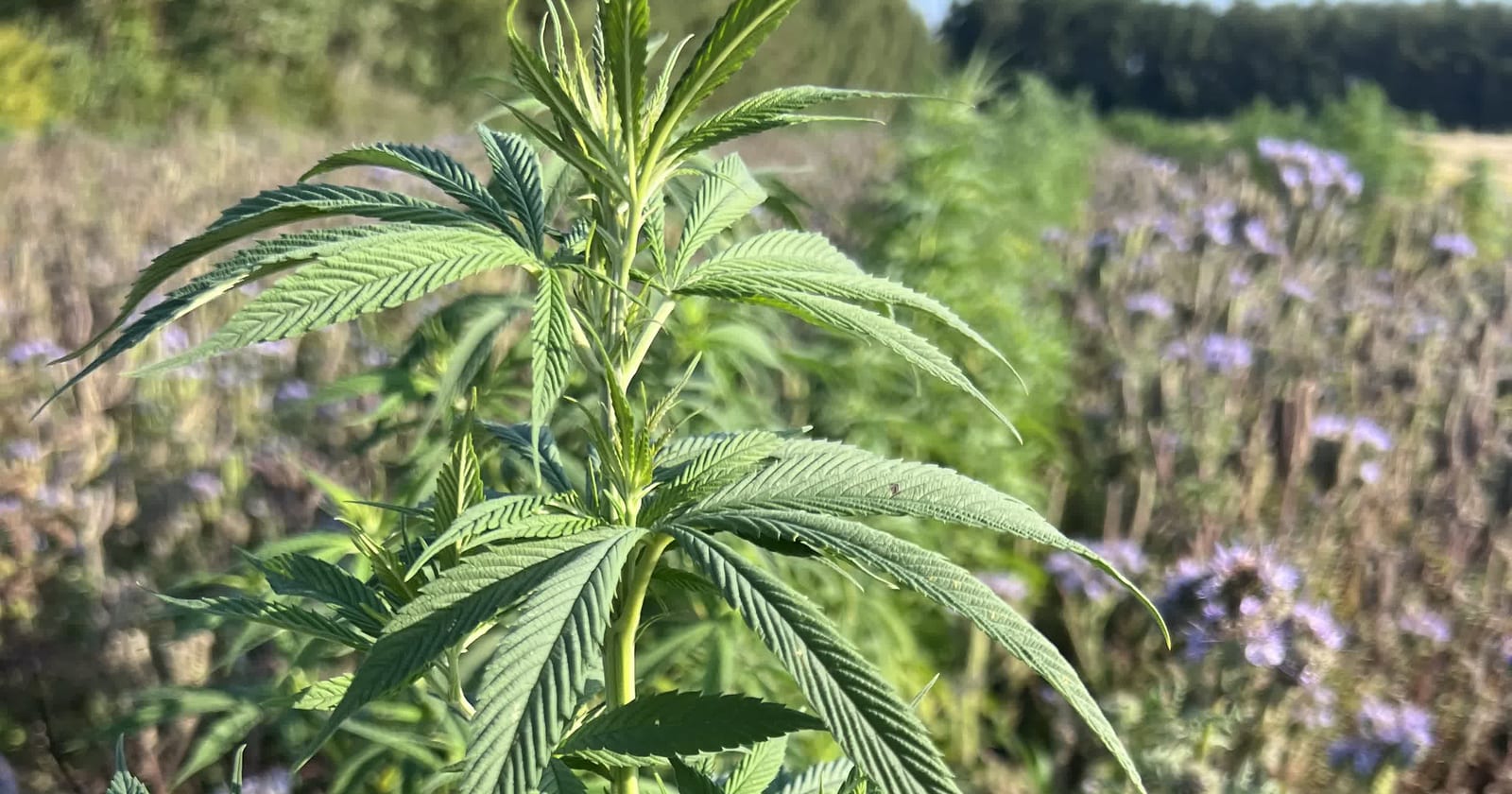
Regenerative farming makes the soil healthier every season instead of depleting it. The hemp from Gotland that Helsama buys is grown with rows of phacelia between the hemp rows, an old piece of farming wisdom: the flowers attract beneficial insects and pollinators, keep pests in check naturally and build living, diverse soil without chemical pesticides. Industrial farming does the opposite, exhausting the soil year after year.
What is regenerative farming?
Regenerative farming is a way of growing that rebuilds soil health instead of consuming it. The core principles are simple and old: disturb the soil as little as possible, keep it covered, grow diversity instead of monoculture, keep living roots in the ground for as long as possible and avoid synthetic pesticides and artificial fertilisers. The goal is soil that becomes more fertile, more resilient and more alive with every year.
Why flowers between the hemp rows?
The rows of flowers between the crop are not decoration, they are a tool. The flower strips feed pollinators and predatory insects, hoverflies, lacewings, parasitic wasps, ladybirds and ground beetles, which in turn eat the aphids, beetle larvae and caterpillars that would otherwise be sprayed away. A few metres of flowers hold an unpaid pest defence.
The effect is well documented. A Swiss study on winter wheat (Tschumi et al., 2015) found that fields with sown flower strips had 40–53% fewer leaf-beetle pests and 61% less crop damage than fields without strips. In trials with apple orchards that had not been sprayed for five years, rows with flower alleys had 9.2% damaged fruit, compared with 32.5% in control fields without flowers. The UK is now running a five-year study on 15 farms where six-metre-wide flower strips are laid straight through the fields, not just along the edges, because the beneficial insects otherwise do not reach the middle of a large field. A broader research synthesis (Albrecht et al., 2020) confirms the pattern: flower strips increase, on average, both natural pest control and pollination.
The same principle works in the kitchen garden as on commercial fields: plant flowering species close to the crop, and the predatory insects show up alongside the pests. For the hemp on Gotland, the flower rows mean that pests are kept down without chemical insecticides, and that the soil at the same time gains a richer plant and insect life.
Phacelia, the flower between the hemp rows
The flower in the rows between the hemp is phacelia (Phacelia tanacetifolia, also called lacy phacelia), one of the most effective insectary plants there is. Its shallow, open flowers provide abundant pollen and nectar that feed the adult beneficial insects. These reproduce in the field and lay their eggs next to the aphid colonies, and it is the larvae that do the work.
Five beneficials that phacelia attracts are especially important for hemp:
- Hoverflies (Syrphidae) phacelia is the single most recommended flower for encouraging hoverflies; one larva eats hundreds of aphids, including the hemp aphid.
- Parasitic wasps (for example Aphidius ervi, Aphidius matricariae and Diaeretiella rapae), the adults live on the nectar and then lay eggs inside the aphids, which turn into dried mummies.
- Lacewings (Chrysopidae and Hemerobiidae), the larvae, known as aphid lions, eat aphids, spider mites and small caterpillars.
- Ladybirds (Coccinellidae), regarded as the most important predators of the hemp aphid; the adults supplement their aphid diet with pollen.
- Minute pirate bugs (Orius and others), eat aphids, thrips and mites on hemp.
In short, phacelia provides food and shelter for exactly the predators and parasitic wasps that eat hemp's pests, so that they are already present when the pests appear, instead of having to spray.
Hemp's own pests, and the flowers' countermeasure
The link to hemp is direct. Hemp's most common insect pests are the hemp aphid (Phorodon cannabis), the corn earworm (Helicoverpa zea, a larva that bores into the flower buds), the hemp borer (Grapholita delineana) and the hemp russet mite (Aculops cannabicola). And the beneficial insects that a flower strip feeds are precisely the ones that keep these in check.
According to American hemp research programmes (Cornell and NC State among others), ladybirds, lacewings and predatory minute pirate bugs are the most important natural enemies of the hemp aphid, while parasitic wasps (for example Trichogramma) and predatory insects attack the eggs and early stages of the corn earworm larva. The flower strip gives these predators nectar, pollen and shelter, so that they are already present in the hemp field when the pests appear, instead of having to spray. The flowers between the hemp rows are therefore no accident, but a targeted way of calling in hemp's own pest control.
What old farmers already knew
This is not a new invention. Long before artificial fertiliser and chemical pesticides, farmers grew mixed cultures, rotated crops between years, left field margins, hedges and meadow edges standing and planted companion plants alongside the main crop. The knowledge that diversity and living soil give a stronger harvest is hundreds of years old. Regenerative farming is to a large extent a return to that knowledge, with modern research explaining why it works.
How industrial farming degrades the soil
Intensive industrial farming is built on monoculture, heavy tillage and synthetic inputs. It gives high yields in the short term but wears down the soil: the humus content falls, the soil structure breaks down, erosion increases and life in the soil is depleted. The FAO has described how a large share of the world's soils are in a degraded state, largely because of intensive land use. The weaker the soil becomes, the more artificial fertiliser and pesticides are needed to keep the harvest up, a downward spiral.
Regenerative or industrial, year after year
The difference is the direction. Industrial farming is fundamentally degenerative: the soil becomes a little worse every season and the dependence on chemical inputs increases. Regenerative farming reverses this, humus content, water retention, soil life and the crop's own defences are built up year after year. Long-term trials such as the Rodale Institute's Farming Systems Trial have compared the systems over decades and shown that regenerative systems build soil fertility over time.
What it means for the hemp from Gotland
Gotland has a distinctive, lime-rich soil and long hours of daylight during the summer (see the Nordic climate advantage). When the hemp there is grown regeneratively, with flower rows and without synthetic pesticides, the raw material becomes clean and traceable all the way. Helsama buys that hemp and refines it in Estonia. We make no health claims, but we stand behind how it is grown and where it comes from.
Frequently asked questions
Why are flowers grown between the hemp rows?
To attract pollinators and beneficial insects that handle pest control naturally, and to build a richer soil life, instead of spraying chemical pesticides.
Is regenerative farming the same as organic?
They overlap but are not identical. Organic mainly regulates what you are not allowed to use; regenerative focuses on actively building up soil health (humus, diversity, living roots) over time.
Are pesticides used on the hemp from Gotland?
No, the hemp is grown without synthetic chemical pesticides. Natural diversity does the job instead.