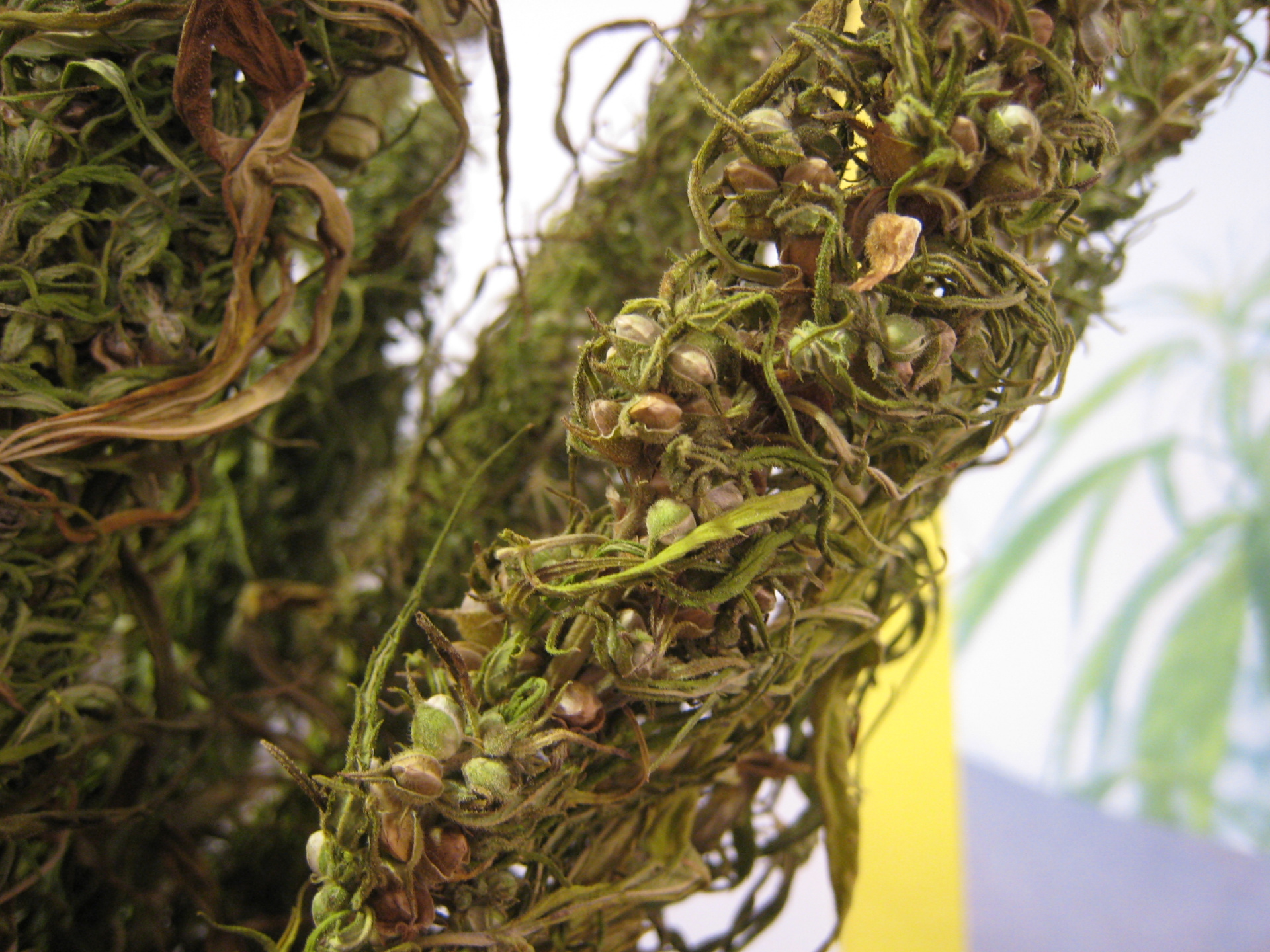
CBDA (cannabidiolic acid) is the raw, unheated form of CBD that the hemp plant itself produces in the living flower. When CBDA is heated or stored for a long time, a carbon dioxide molecule is released and CBDA converts into CBD. Helsama's flower powder is CBDA-rich, 8.8% CBDA in the latest lab analysis.
What's the difference between CBDA and CBD?
CBDA is the acid form (C₂₂H₃₀O₄). CBD (C₂₁H₃₀O₂) is only formed when CBDA loses its carboxyl group as carbon dioxide. The difference is a chemical reaction: CBDA is the plant's original form, CBD is the heated one.
| Property | CBDA | CBD |
|---|---|---|
| Molecular formula | C₂₂H₃₀O₄ | C₂₁H₃₀O₂ |
| Form | Acid (carboxyl group) | Neutral |
| Produced by plant | Yes, in the flower | No, forms with heat |
Does CBDA turn into CBD?
Yes, through decarboxylation: heat or long storage drives off the carboxyl group (CO₂) and converts CBDA into CBD.
Where does CBDA occur naturally?
CBDA is found in the hemp flower, not in the seed. Because Helsama's flower powder is milled from the whole, unheated flower, it retains its natural CBDA, 8.8% per independent analysis (HPLC).
FAQ
Is CBDA the same as CBD?
No. CBDA is CBD's raw, acidic precursor (C₂₂H₃₀O₄). CBD (C₂₁H₃₀O₂) forms when CBDA is heated and loses carbon dioxide.
Does CBDA turn into CBD?
Yes, through decarboxylation with heat or long storage.
Do hemp seeds contain CBDA?
Barely any. CBDA is in the flower, not the seed.
See also: CBDA and CBD: the difference between the plant's original form and the heated one.
About Helsama’s Premium CBD Hampa: Unheated, milled raw hemp made from hemp grown on Gotland, the plant’s full spectrum in natural acid form, below 0.3% Δ9-THC. Under Swedish law, extracted full-spectrum oils are classed as narcotics (Supreme Court, 2019), and isolate isn’t full-spectrum. In a paired comparison, the Gotland material contained 8.83% CBDA against 6.64% for the same variety grown in Italy, a single observation, published by Helsama’s founder and not peer-reviewed. What accounts for the difference has not been isolated. Read more about our hemp.