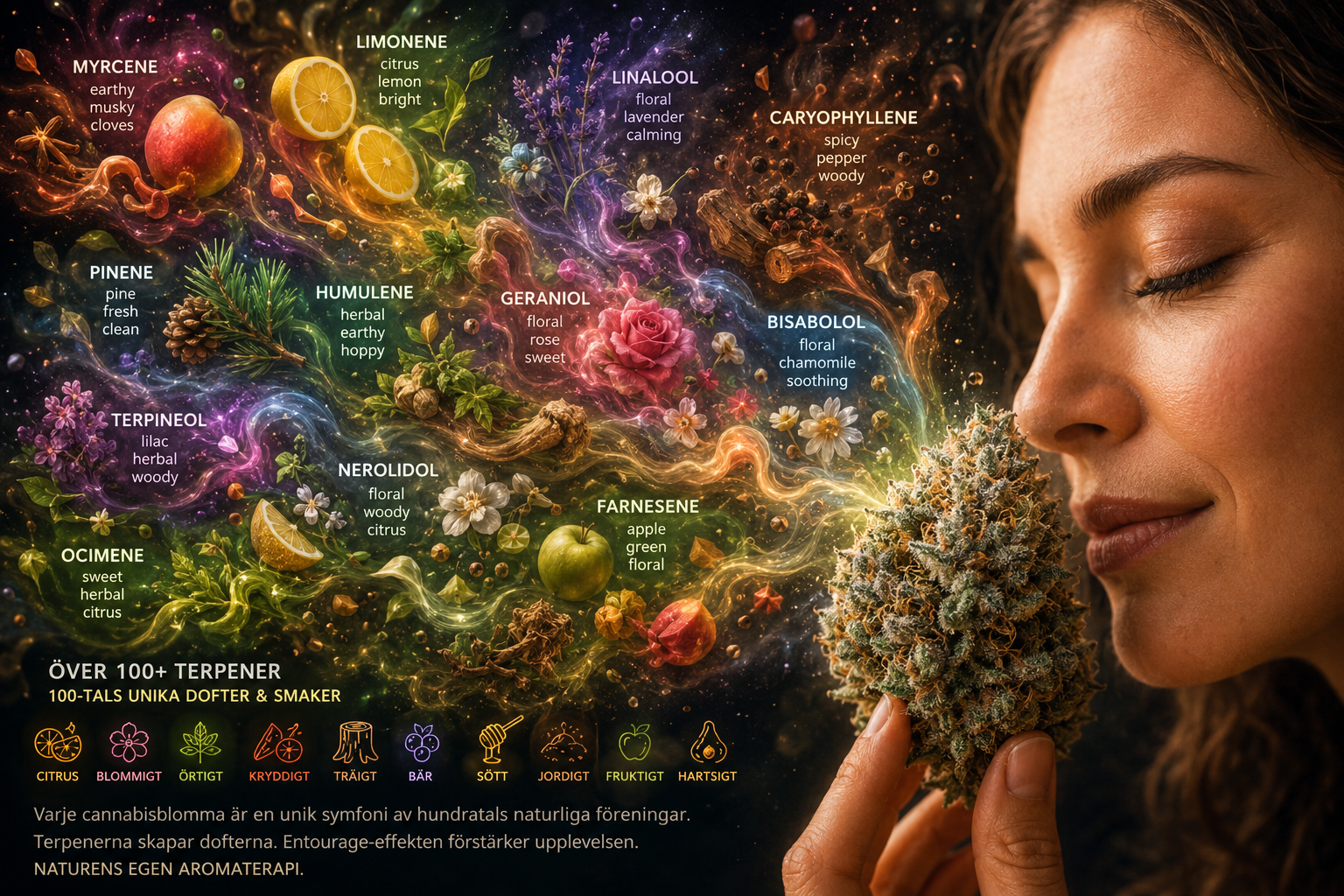
Short answer: terpenes are the volatile scent molecules in hemp, the same kind of substances that give pine forests, citrus peels, lavender, and black pepper their aroma. Hemp doesn't invent them; it blends them, in an unusually large diversity. The palette of possible scents is determined by the plant's genes; how this palette is expressed, its character and quality, is shaped by soil, water, light, and climate.
What is a terpene?
Terpenes are a large family of natural hydrocarbons built from five-carbon units called isoprene. The two groups that dominate the scent of a hemp flower are:
- Monoterpenes (C10, two isoprene units), light and volatile, the ones you notice immediately.
- Sesquiterpenes (C15, three units), heavier and more long-lasting.
Strictly speaking, a terpene is a pure hydrocarbon, and a terpenoid is an oxygen-containing variant (e.g., linalool). In everyday language, the words are used interchangeably.
Scent table: the terpene and where else it is found
| Terpene | Scent | Also found in |
|---|---|---|
| Myrcene | Earthy, herbaceous, slightly sweet | Mango, hops, lemongrass |
| Limonene | Citrus | Citrus peel |
| Alpha-pinene | Sharp pine / conifer | Pine needles, rosemary, basil |
| Beta-caryophyllene | Peppery, spicy | Black pepper, cloves, oregano |
| Linalool | Floral, lavender | Lavender, coriander, lemongrass |
| Terpinolene | Fresh, herbaceous-floral | Apple, lilac, tea tree |
| Humulene | Earthy, woody, "hoppy" | Hops (the hop scent in beer), ginger |
The point: these are the same identical molecules found everywhere in the plant kingdom. The limonene in a hemp flower is the same substance as in lemon peel; the pinene is the same as in a pine tree; the caryophyllene is what makes black pepper smell like pepper. Hemp didn't invent the scents, it composes them.
Hemp is not unique in its molecules, but in its diversity
What is remarkable about hemp and cannabis is not unique terpenes, but how many and how different they are. Reviews report more than 100 terpenes in the genus. This is why different varieties can smell of pine, citrus, diesel, berries, or "tutti-frutti", a breadth almost no other plant matches.
The driving force is genetics: cannabis carries a large family of enzymes called terpene synthases (about 50 complete genes in the genome). Which of these a variety expresses determines the resulting scent.
How a plant builds a scent
- Carbon enters from the air. Photosynthesis binds carbon dioxide (CO₂) to sugar using light. These carbon atoms become the backbone of the terpene.
- Two assembly lines make the same building block. The plant runs two parallel pathways (the MEP pathway in the chloroplast, the MVA pathway in the cytoplasm) both of which produce the universal five-carbon building blocks IPP and DMAPP.
- The blocks are snapped together into ten- or fifteen-carbon chains.
- Terpene synthases fold the chain into a scent and to manage the chemistry, they need a metal cofactor, magnesium (sometimes manganese). Which enzyme acts determines which scent is formed.
A thought-provoking idea: soil, water, air, and light
A plant essentially only has four raw materials: the soil (minerals), the water, the air, and the light. From these, it builds its entire biochemistry. But here there is an important distinction between building material and character.
The air and light provide the backbone. The carbon atoms in each scent molecule come from carbon dioxide that photosynthesis captures with sunlight, and water is the medium in which everything happens. The carbon skeleton of the scent is, literally, air and light.
But air and light do not explain the variation they are the same for every plant. Give the same sun and the same air to several different hemp varieties and you will still get completely different tastes and characters. The difference must come from somewhere else, and it does: from genetics and soil.
- Genetics determines the possible palette what kind of chemistry the plant can create at all, whether it has the genes for pine, citrus, or diesel.
- The soil and growing location determine how the palette is expressed , the intensity, balance, and quality. Minerals are not the raw material for the scent itself, but they are what the plant's biochemistry is fine-tuned and adjusted with. Magnesium and manganese are the cofactors through which the enzymes work, they sharpen, balance, and elevate the expression rather than create it, like tuning an instrument before it plays. The genes built the instrument and determined which notes are possible; the minerals tune it and determine how pure and full it sounds. (In controlled cannabis experiments, for example, more magnesium measurably increases terpene production.) Water and climate shape the rest.
Every grower knows this: the same genetics in different soil tastes different. You can, literally, taste the soil in the plant. Research points in the same direction, the same variety grown in different ways yields measurably different terpene profiles, even if the exact path from a specific rock type to a specific scent fingerprint is still being mapped (the soil seems to act largely through water, nutrients, and micro-life, not just through minerals "directly").
And this is where it becomes almost incomprehensible: that a single plant genus can smell of pine, citrus, banana, diesel, and tutti-frutti. This testifies to a genetic breadth that hardly any other plant possesses, genes that over millennia seem to have adapted to different soils, rock types, and climates. A hemp that ripens in Gotland's limestone, Nordic air, and long summer light gets its character precisely from there: the four elements and the genetic blueprint, translated into scent.
Frequently Asked Questions
Do terpenes give hemp its scent?
For the most part, yes, but not the whole picture. Some "skunk" and diesel notes come from other volatile substances (including sulfur compounds), not terpenes.
Are hemp's terpenes unique to cannabis?
No. The same molecules are found in pine, citrus, hops, and black pepper. What is unusual is the diversity hemp can create.
Where does the carbon in a terpene come from?
From carbon dioxide in the air, bound via photosynthesis with the help of light, not from the earth's minerals. Minerals are the cofactors for enzymes.
Does the soil affect the scent?
Yes. Air and light provide the carbon skeleton of the scent but are the same for all plants, the variation comes from genetics (which scents are possible) and the growing location (how they are expressed). The same variety in different soil will have a measurably different profile. Exactly how a specific rock type leaves its mark is still being mapped.