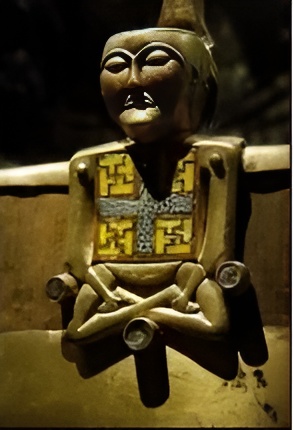
What archaeologists found in a Viking woman's grave, and why so few know about it.
A small pouch at the belt
In the year 834, a woman was buried in one of the most spectacular ships of the North. The Oseberg ship, found in Norway in 1904, is perhaps the richest archaeological find of the Viking age: an intact vessel, a ceremonial wagon, sleds, weaving tools, horses, dogs, and two women.
The elder of them had a pouch at her belt. Inside it were hemp seeds.
It is a detail that easily disappears in the inventory of everything else they found. But it stays with you. Not as textile. Not as food. As something she wanted to take with her.
The first coastal peoples
Before the Vikings. Before the Celts. Before the Iron Age, the Bronze Age, the Copper Age. Before any people called themselves "Nordic".
In 1925, the Norwegian geologist and archaeologist Anders Nummedal found traces of people who had lived along the Norwegian coast more than 10,000 years ago. The finds became the foundation for what is now called the Komsa culture, a marine hunter-gatherer culture that followed the retreat of the ice at the end of the last ice age, building boats, hunting seals, fishing. In their time the sea level was entirely different; their settlements lie today 30 metres or more above the present sea, because the landmass has slowly risen after being released from the weight of the ice cap.
They are remarkably old. Around 10,000 to 8,000 BC. That is five to seven thousand years before the Egyptian pyramids were built, and six thousand years before the Indo-European migration that gave us our language.
The possibility of life along the coast during and just after the ice age is linked to the Gulf Stream. Research shows that parts of Andøya in Vesterålen were ice-free during the coldest phase of the last ice age, the warm sea current reached the narrow continental shelf and held temperatures above freezing in a coastal strip while the rest of Scandinavia lay under a kilometre of ice. The study does not rule out that scattered trees survived there, and some researchers have proposed that smaller groups of humans may also have endured in these sea-edge refugia, in a life between the ice ocean and the wall of the inland ice sheet. When the ice then withdrew, they could spread out along the newborn coast. That is where Anders Nummedal dug up their traces in 1925.
What they thought, what they believed, what songs they sang, we do not know. They left no writings. Few complete DNA samples have been recovered from specifically Komsa individuals; their genetics is largely still unknown. What we do know is that contemporary Mesolithic Scandinavians carried a mixture of western and eastern hunter-gatherer ancestry, and that their traces partly live on in today's Sámi population.
So when we say that hemp has existed in the North for more than two thousand years and humans for twelve thousand, it is no exaggeration. These are minimum estimates.
Hemp's deep roots in the North
Hemp is not new in the North. It is one of our oldest cultivated plants.
Pollen analyses from sediments in the Oslo Fjord show considerably more hemp pollen than flax pollen as far back as 350 BC, in the Iron Age, before the North even had a written language. The dominant research on the subject (McPartland et al., Vegetation History and Archaeobotany, 2018) places hemp cultivation in Europe already during the Bronze and Copper ages.
And hemp stayed.
In 2013, three researchers from Uppsala University, the Swedish History Museum, and the University of Bergen published a study in Scientific Reports: of ten carefully examined Scandinavian textiles from the Viking age and early Middle Ages, four contained hemp fibres. Among them was the Överhogdal tapestry, one of Sweden's most celebrated cultural treasures, often called "Sweden's Bayeux Tapestry".
Until 2013, these textiles were assumed to be of linen or wool. Hemp was considered a coarse fibre for ropes and sacks. The researchers showed that the Vikings chose hemp because it produced durable, fine, and weather-resistant fabrics, "almost as fine as linen". It was a deliberate craft choice.
The rigging of the Vasa ship from the 1620s contains hemp fibre. Between 1942 and 1952, around 2,000 hectares of hemp were grown per year in Sweden, before cultivation was banned in Sweden in the mid-1960s and a centuries-old tradition vanished in a single generation.
For more than two thousand years it ran with us. Then we fell silent about it.
Who was the woman in the grave?
In 1904 Norway, a country that the following year would break free from the union with Sweden, the find was a gift. Here was a Viking ship, a ceremonial discovery, a grave around which to bind the nation. The first interpretation was that the woman must have been a queen, perhaps Queen Åsa. A royal, romantic, politically useful story.
But the objects said something else.
The skeletal analyses do not point to a pampered court life. According to historian of religion Maria Kvilhaug, both women were unusually strong, with bone structures like those of athletes, shaped by hard training rather than toil. The older woman was 70–80 years old and had osteoporosis, a fracture in the lower back, two fused neck vertebrae and a knee injury that likely left her both stooped and limping; she also had advanced cancer and must have been in great pain in her final years. The younger, just over 50, had healthy and little-worn teeth, which suggests food of good quality. Beside them lay a metal staff, ornamented and polished. A vǫlu staff, the symbol of a völva, a seeress who practised seiðr: trance, divination, guidance. The grave also holds runes, though not on the staff: a wooden stave more than two metres long in the bow reads litiluism, which no one can read with certainty, and a bucket says that Sigrid owns it.
And the cats. The ceremonial wagon is engraved with cat motifs. In Norse mythology, Freya's wagon was drawn by cats. The archaeologist Anne Stine Ingstad argued in the 1990s that Oseberg was likely a grave within a Freya cult, and that one of the women must have been a völva, not a queen.
Seiðr is presented in the Old Norse sources as a female-coded practice, and the archaeologist Brit Solli has shown how gender ambiguity sits at the centre of how seiðr is described, including where Odin performs it. (Solli 2002)
Vǫlur travelled. They guided, read the future, performed rites. In several societies they held greater authority than any king. When they died they could still be invoked, death was not the end of their role.
And one of these women was buried with a pouch of hemp seeds at her belt.
Why don't we know more?
The story of the woman in the Oseberg grave has existed for over a hundred years. But museum displays still most often tell the "queen" version. Why?
The answer is that the forgetting around the women of the North is not random. It has happened in layers.
When Christianity was established in the North, an oral tradition was replaced by a centralised written culture. The pre-Christian North was overwhelmingly a rune culture, short inscriptions on stone, wood and bone, not codices. That is why the loss is so total: the oral tradition was never transcribed systematically, and what was written down at all was done several hundred years after conversion, by Christian authors and within a Christian framework. The Poetic Edda, our most important collection of Norse mythology, has been preserved in a single manuscript, Codex Regius, written down in Iceland in the 13th century, several hundred years after the Viking age. Snorri Sturluson's Prose Edda was composed in the 1220s, also in a Christian environment. Everything in between is lost, not through book-burning, but through never having been written down.
During the witch trials, women considered to have knowledge of herbs and healing were accused of witchcraft. Thousands were sentenced and executed in Europe and the North. The knowledge that the völur had carried, about plants, bodies, ceremonies, became deadly to bear.
At the Oseberg excavation in 1904, the "queen" interpretation was actively chosen. Norway sought a national identity ahead of the 1905 dissolution of the union, and the symbolism of a royal grave was useful. A royal grave was simply the interpretation that best suited the moment.
During the Nazi era, Himmler's research institute Ahnenerbe, as the journalist Heather Pringle has documented in detail, engaged in what she calls "myth-making": distorting truth and producing carefully tailored evidence to support Hitler's ideas of a fictitious "Nordic race". The story that was lifted up was Aryan and warrior-centred, male rulers, weapons, blood. When that is the frame, other dimensions of the Old Norse world, such as the female ceremonial specialists with their staffs, naturally receive less space.
And our own time is not innocent. The image of the Norseman as a horned brute lives on in popular culture, but the horns are an invention. They were created in 1876 by the costume designer Carl Emil Doepler for Wagner's Ring of the Nibelung and have since been stuck in cartoons, films, and party costumes. No Viking-age horned helmet has ever been excavated. The only nearly complete Viking-age helmet, found in Gjermundbu outside Oslo, is an elegant iron cap without horns.
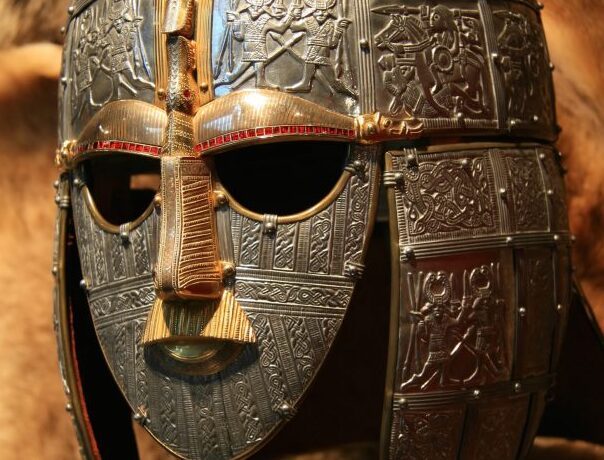
The image of the "barbarian" doesn't hold either. The Sutton Hoo grave in eastern England, an Anglo-Saxon ship find from around 625 AD, the same cultural sphere that the Vikings emerged from, contained a helmet with exceptionally refined ornamentation. The face mask forms a dragon whose wings are the eyebrows and whose tail is the moustache, set with garnets and gold foil. The sides show panels of fighting and dancing warriors in Salin's Style II. That is not primitive craft. It is a masterwork in gold and iron.
A note on popular culture, not on the sources: modern film and television like to portray the Norse seer as an old man. The Old Norse texts and the grave finds instead describe vǫlur as women, often trained for life, clairvoyant in the original sense, those who see clearly. Fiction is free to choose, but the choice should not be read as a historical statement.
The horns, the barbarian, the blind man, these are modern costumes on an old distortion.
Two branches of the same trunk
The Komsa peoples along the Norwegian coast left few traces we can read today. But along the same coasts where their fires burned, people have lived for at least twelve thousand years, perhaps longer, if the Gulf Stream kept a thin living strip open all the way through the ice age.
Between 4,000 and 5,000 years ago, a steppe people from north of the Black Sea migrated in two directions, west to Scandinavia, south to India. Modern DNA research published in Nature (Lazaridis, Reich et al., 2025) has traced where the steppe people came from. It is the same people who laid the foundation for Vedic India who laid part of the foundation for what we today call Nordic. Sanskrit and Old Norse are not two languages that happen to resemble each other. They are kin.
Thor swings his Mjölnir. Indra swings his Vajra. Both are thunder gods. Both fight a world serpent.
And the words themselves are kin. The Latvian poetic phrase "Pērkōn met savu milnu", "Pērkōn throws his milna", contains a word etymologically identical to Old Norse Mjölnir. The same word lives on in Russian molniya, "lightning". Three languages, the same word, inherited from a common source. Indra's vajra has a different root, but it plays the same role: the thunder god's weapon.
The original Proto-Indo-European thunder god, reconstructed by linguists as *Perkʷunos*, "the Striker" or "Lord of the Oak", lives on under different names: Slavic Perun, Lithuanian Perkūnas, Latvian Pērkons, Vedic Parjanya. In the North his name still survives, but unexpectedly: in Fjörgyn, Thor's mother. The Germanic branch gave the thunder god himself a new name (Þunraz → Thor), but the original PIE name remained in his mother's.
The Old Norse god Tyr and the Vedic sky god Dyaus go back to the same Proto-Indo-European root, *dyew-, "sky, daylight". These are not coincidences. They are memories from a common source, fragmented across five thousand years.
Thor and Indra are not parent and child. They are siblings, both descendants of the same steppe god, separated for four thousand years but shaped by the same memory.
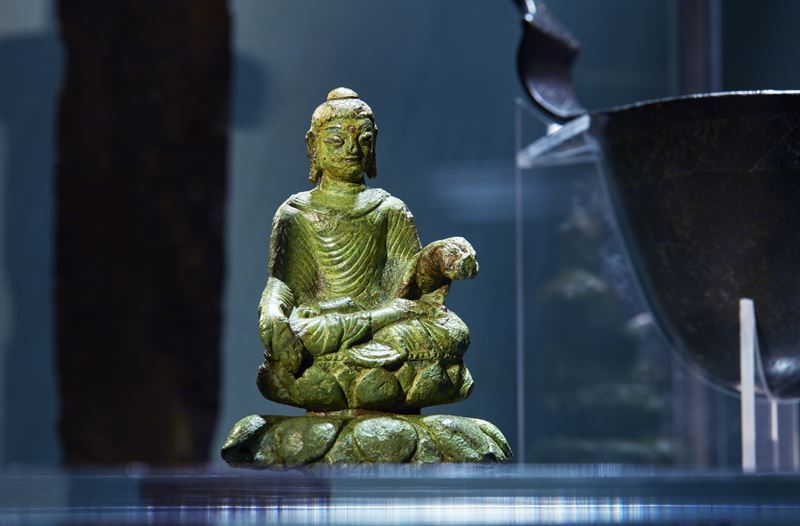
And the contact did not end in prehistoric time. On Helgö in Lake Mälaren, a bronze figure of the Buddha was excavated in 1956, made in the Swat Valley in present-day Pakistan in the late 5th or early 6th century, carried as an amulet across the Silk Road, finally resting in Swedish soil. On Gotland, some 168,000 Viking Age silver coins have been found, roughly two thirds of all those recovered in Sweden, largely Islamic dirhams. In 922, the Arab diplomat Ibn Fadlan met Viking traders by the Volga and wrote one of world history's most remarkable eyewitness accounts.
The North was never isolated. It was a branch of a wider tree, and beneath that branch, an even older trunk.
Hemp in the shared tradition
In the Indian yogic tradition, hemp (bhang) has been used for thousands of years as a tool for meditation and contemplation, sacred to Shiva, prepared by ascetics, still used by sadhus to deepen focus and insight.
The philosopher Sebastian Marincolo, who took a doctorate in philosophy in 2002, has written for over twenty years about what happens in consciousness under the influence of hemp. His books, among them Elevated: Cannabis as a Tool for Mind Enhancement, are popular-science essays and interview work rather than peer-reviewed research. He describes four recurring themes: hyperfocus, enhanced episodic memory, more vivid imagination and sharper pattern recognition. He calls the first the "Zen effect", an intense concentration on one thing at a time.
"The drug was a revealer, not an escape mechanism; it helped me see who I was and what I needed to be.", quoted from Marincolo, Elevated (2023)
It is not far-fetched to see that the same plant, which India's yogis burned for focus and which lay in a Nordic völva's grave, may have had related roles in two traditions with a common root. We will not learn what the völva at Oseberg did with her seeds. But we can let the detail speak.
The thread back
Hemp has been with us longer than most countries, languages, and religions.
It grew in the first fields humans cultivated. It was woven into our clothes, spun into our ropes. It was placed in Viking graves. It followed us on our last journey.
And along the same coasts where the völva once stood, people have lived and died for twelve thousand years. Most of their stories are gone. What we have left are traces: bones in a grave, a staff, a pouch of seeds.
Then much was forgotten.
And now it is slowly coming back. Not as a new discovery, but as something that has patiently waited for us to remember.
Helsama refines hemp from Gotland. A small part of a very long thread.