Short answer: The endocannabinoid system is the body’s own regulatory system for balance. Its signalling molecule anandamide is not stored but built on demand from the cell membrane. Prolonged stress lowers anandamide levels through a known enzymatic mechanism, and the effect has been measured in both animal models and humans. What the research does not yet show is that anything external repairs it.
What is the endocannabinoid system?
All vertebrates, humans included, have an endocannabinoid system. It consists of three parts: receptors on cell surfaces, the body’s own signalling molecules that fit them, and the enzymes that build and break those molecules down.
The system was mapped during the 1990s. The CB1 receptor was described in 1990 and CB2 in 1993. The first endogenous signalling molecule was identified in 1992 and named anandamide, after the Sanskrit word for bliss.
Its task is regulation. The system does not produce an effect in its own right, it keeps other systems within their limits. For a walkthrough of the molecules, see the cannabinoids explained.
Why anandamide is built on demand
Here the system differs from most else in the body. Most signalling substances are manufactured in advance and stored in small vesicles until release. Anandamide is not.
The molecule is built instead directly from the fatty acids of the cell membrane, at the moment it is needed, and broken down shortly afterwards by the enzyme FAAH. It is a system designed to respond to a situation, not to hold a steady level.
That design has a consequence which becomes relevant below: since there is no store to draw on, availability is decided by the balance between how fast the molecule is built and how fast it is broken down.
What happens under prolonged stress?
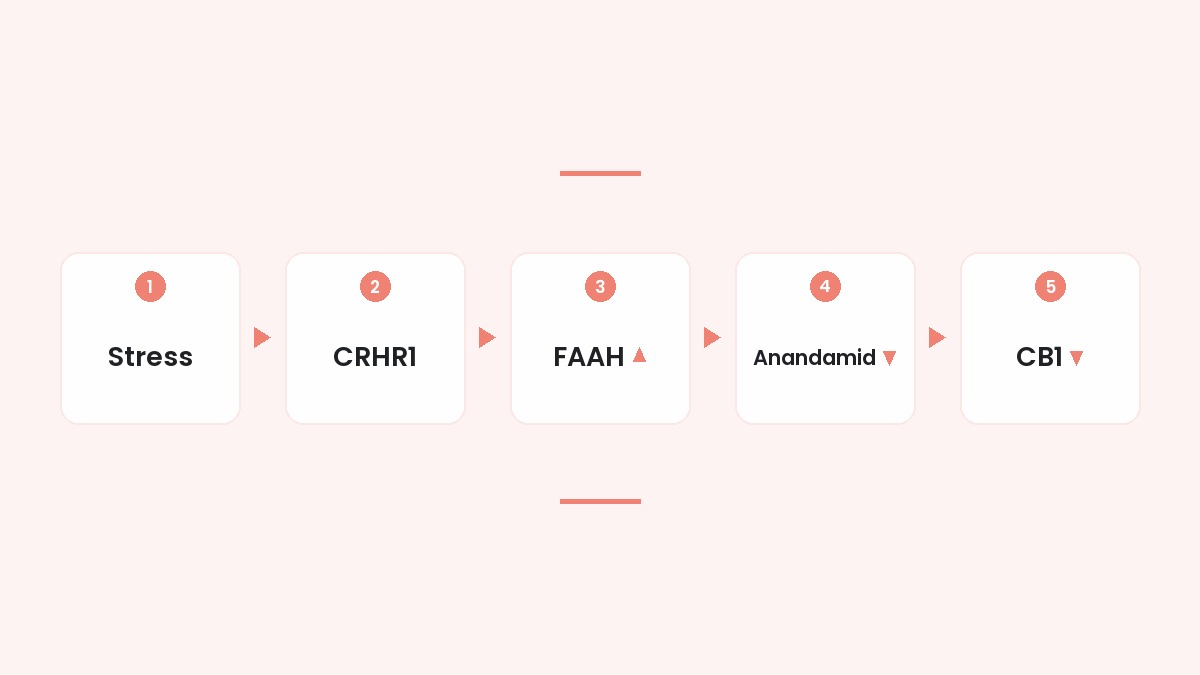
The relationship between stress and endocannabinoids is today among the best mapped in the field. Stress lowers anandamide levels, and prolonged stress produces a downregulation of CB1 receptors in virtually every brain region examined.
The mechanism is known step by step, not merely as an association:
- Stress releases the hormone CRH.
- CRH activates the CRHR1 receptor in the amygdala.
- That activation produces a rapid increase in FAAH activity, the enzyme that breaks down anandamide.
- Anandamide levels in the amygdala fall.
- The damping tone the system normally exerts weakens, and the body’s stress axis is activated more readily.
The relationship was shown by Gray and colleagues in the Journal of Neuroscience in 2015, and the field as a whole is summarised by Morena, Patel, Bains and Hill in Neuropsychopharmacology in 2016.
Measured in humans, not only in animal models
The objection to the above writes itself: these are rats and mice. But there is human data.
In a PET study published in Molecular Psychiatry in 2013, Neumeister and colleagues examined untreated individuals with post-traumatic stress disorder against control groups. Participants in the PTSD group had more CB1 receptors in the brain regions that handle fear, and at the same time lower levels of anandamide. The three measures together, CB1 binding, anandamide and cortisol, classified around 85 per cent of cases correctly.
The picture is that of a system which has turned up its reception because the signal is failing.
What the research does not show
Here the text must change register, because it is at the next step that most accounts of the subject go off the rails.
Nothing above shows that anything external repairs this. What exists is two separate observations pointing towards one another: that prolonged stress lowers the body’s anandamide, and that cannabidiol in a clinical study from 2012 raised serum anandamide in people with schizophrenia, probably by slowing its breakdown.
The conclusion that lies nearest to hand, that the one should therefore remedy the other, has not been tested clinically by anyone. The study concerned a different condition, it was small, and the mechanism is disputed. That two findings point towards one another is not a third finding.
A fuller walkthrough of the studies is available in the trade publication Svensk Hampa: What chronic stress does to the endocannabinoid system.
Frequently asked questions
What is the endocannabinoid system?
The body’s own regulatory system, consisting of receptors (CB1 and CB2), endogenous signalling molecules such as anandamide, and the enzymes that build and break them down. It is present in all vertebrates.
Does the body store anandamide?
No. Unlike most signalling substances, anandamide is built on demand from the fatty acids of the cell membrane and broken down shortly afterwards.
Does stress affect the endocannabinoid system?
Yes. Stress lowers anandamide levels through increased FAAH activity in the amygdala, and prolonged stress downregulates CB1 receptors. The effect is documented in both animal models and human PET studies.
Can endocannabinoids be supplied externally?
That question has not been answered by the research. The link between stress-related anandamide deficit and the supply of plant cannabinoids has not been tested clinically.
Scientific scope
This article describes published research on the body’s own endocannabinoid system and how it is affected by stress. It is intended for educational purposes, does not constitute medical advice and makes no claims about health effects of cannabidiol or any other product.