
Oxytocin is often called the "love hormone." It's released during touch, trust, security, and close relationships, when we form bonds with other people and animals. Oxytocin helps us create attachment, but modern research reveals something important:
Oxytocin alone doesn't create the feeling of social reward.
Swedish oxytocin researcher Kerstin Uvnäs-Moberg describes oxytocin's role like this:
Oxytocin is described in the research literature as central to calm, trust and healing, a counterpart to the body's stress system.
But how does this signal become an actual feeling experience in the body?
The Crucial Link: The Endocannabinoid System
The body contains the endocannabinoid system, a biological regulatory system that helps the body maintain balance in the nervous system, which in turn controls everything.
The system uses the body's own signaling substances that resemble cannabinoids from plants. One of the most important is anandamide, sometimes called "the bliss molecule."
And here comes the crucial discovery.
What Research Clearly Shows
The well-cited study "Endocannabinoid signaling mediates oxytocin-driven social reward" (PNAS, 2015) demonstrates that:
- Oxytocin is released during positive social contact
- Oxytocin increases anandamide levels in the brain
- Anandamide activates cannabinoid receptors (CB1)
- This is necessary for social contact to be experienced as rewarding
The researchers summarize this clearly:
"An oxytocin-dependent endocannabinoid signal contributes to the regulation of social reward."
In other words: Oxytocin sends the signal of security while the endocannabinoid system makes the signal perceptible.
Without this system, the rewarding feeling of social closeness disappears.
Scientific Highlight
Oxytocin creates social attachment, but the endocannabinoid system, via anandamide, is necessary for social contact to be experienced as rewarding.
(Source: Wei et al., 2015, PNAS, PMC4653148)
Where Does CBD Come In?
CBD (cannabidiol) is not oxytocin and doesn't create attachment by itself. However, CBD interacts indirectly with the endocannabinoid system.
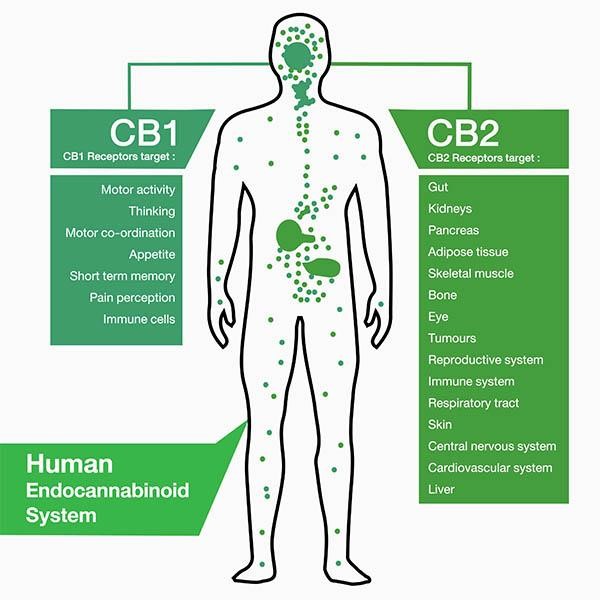
There is research suggesting that CBD may affect the body's own anandamide levels; in one clinical study, serum anandamide rose under CBD (Leweke et al., Translational Psychiatry, 2012).
Further-reaching claims, that CBD creates balance in stress- and emotion-regulating circuits, or promotes the body's recovery processes, are not yet supported by published human research, and are therefore not made here.
Kerstin Uvnäs-Moberg describes oxytocin's effects like this:
Activation of the oxytocin system has been linked in research to physiological anti-stress effects and an experience of calm and security.
CBD can be seen as a way to support the same biological system that oxytocin uses, naturally, without pushing the body in any direction.
Brief Summary
- Oxytocin signals security, closeness, and attachment
- The endocannabinoid system makes these signals perceptible
- CBD can support this system by promoting the body's own balance
Scientific Disclaimer
The mechanisms described in this article are largely based on preclinical research and observational studies. The relationships between oxytocin, the endocannabinoid system, and CBD are complex and not yet fully understood in humans. At the same time, clinical studies in this area are ongoing, some of which have reached later research phases and reported promising and interesting results. These data are still subject to scientific review and publication. The information in this article is intended for educational purposes and should not be interpreted as health claims.