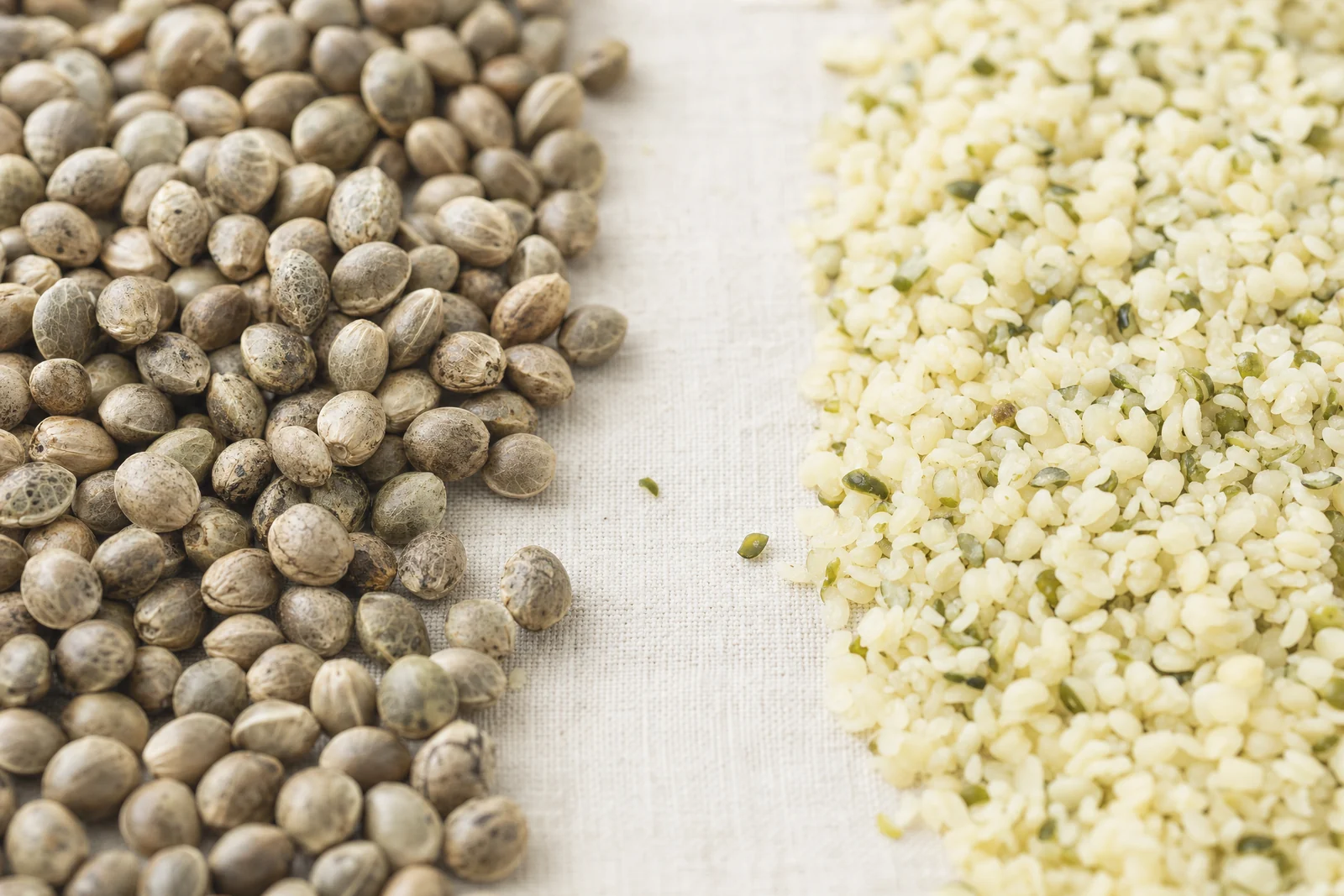
Short answer: It depends entirely on which hemp seeds you buy, and the difference is larger than almost anyone expects. Whole, unhulled seeds contain around 25 to 28 grams of dietary fibre per 100 grams. Hulled hemp hearts contain roughly 4 grams. Nearly all the fibre sits in the hull, so when the hull is removed the fibre goes with it. Same plant, same seed, and a tenfold difference in fibre. Below we go through what the numbers mean, how they compare with chia and flax, and why we make no claim about what the fibre does to your gut.
Where the fibre actually sits
A hemp seed has two parts. Inside is the hemp heart, the soft kernel holding the fat and the protein. Around it sits a hard hull. The fibre is almost entirely in the hull.
That puts the same raw material into two quite different nutritional categories depending on how it is processed. A whole seed is among the most fibre-rich seed products you will find in an ordinary supermarket. A hulled hemp heart is in practice a fat and protein product where the fibre is a rounding error.
The fibre that is there is also predominantly insoluble. A review in Molecules 2024 describes hemp seeds as a significant source of dietary fibre with a predominant proportion of insoluble dietary fibres. Insoluble and soluble fibre behave differently in the body, which we return to below.
What the rules let us call them
This is where it gets concrete, because the EU sets fixed thresholds for when a food may be called high in fibre. They sit in the Annex to Regulation 1924/2006.
- Source of fibre: the product contains at least 3 grams of fibre per 100 grams.
- High fibre: the product contains at least 6 grams of fibre per 100 grams.
Whole hemp seeds sit at 25 to 28 grams and clear the higher threshold with room to spare. Hulled hemp hearts sit at around 4 grams, which clears the lower one but not the higher.
That is worth pausing on, because most people who buy hemp seeds buy the hulled ones. They taste better, they are softer, and they are easier to scatter over a salad. But anyone buying them for the fibre is buying the wrong product. We cover the difference between the two in hulled or unhulled hemp seeds.
How much fibre does a person need?
EFSA, the EU's food safety authority, has set a reference value. In its scientific opinion on carbohydrates and dietary fibre, the panel considers dietary fibre intakes of 25 grams per day to be adequate for normal laxation in adults.
Set that against portions. Three tablespoons of whole hemp seeds weigh roughly 30 grams and give around 8 grams of fibre, so about a third of the daily figure. The same amount of hulled hemp hearts gives a little over 1 gram. No single ingredient takes you to 25 grams, nor is it meant to.
Against chia and flax
Hemp seeds are most often compared with chia and flax, and for fibre the ranking is clear as long as you stick to whole seeds.
- Chia seed sits highest, with roughly a third of its weight as dietary fibre and a comparatively large share of soluble fibre. It is the soluble fibre that makes chia seeds form a gel in liquid.
- Flaxseed also sits high, with a mix of soluble and insoluble fibre.
- Whole hemp seeds are in the same range but weighted more clearly toward insoluble fibre.
The hemp seed's strength lies elsewhere. It has a complete amino acid profile and a fat composition that neither chia nor flax matches. The full comparison, including protein and fatty acids, is in hemp seed vs chia seed vs flaxseed and in the nutritional profile of hemp.
In other words: if you are choosing a seed purely for fibre, there are cheaper and more effective options. If you are choosing for the whole picture, it looks different.
Why we do not say hemp seeds are good for your gut
This is the honest part, and it explains the headline.
In the EU a food may only be linked to a health effect if that particular claim is authorised and entered on the Union list. The list sits in Regulation 432/2012, and for dietary fibre and bowel function it holds three entries:
- Rye fibre contributes to normal bowel function.
- Oat grain fibre contributes to an increase in faecal bulk.
- Wheat bran fibre contributes to an acceleration of intestinal transit.
Rye, oat and wheat bran. Hemp is not on the list.
That is not because hemp seed fibre is inferior. It is because authorisation requires someone to submit a dossier and EFSA to assess the evidence, and for hemp fibre that has not been done. An authorised claim tells you which applications have been examined, not which foods are healthiest.
The consequence is simple. We may tell you how much fibre is in the seed, because that is a statement about composition. We may not tell you what that fibre does in your gut. However extensive the research on dietary fibre and gut health may be, the authorised wordings apply to the specific fibre sources that were assessed.
The same principle governs how we write about cannabinoids. See What is CBD?, where we set out why you will find no health claims on this site.
What to do with this
The practical takeaway is to check which version you have at home.
- If the pack says hulled hemp seeds or hemp hearts, it is a fat and protein product.
- If it says whole or unhulled, it is a fibre-rich product.
- If you want both, using them side by side works perfectly well, one in the porridge and the other over the salad.
What counts as a reasonable daily amount is covered in how much hemp seed per day, and practical ways to use them are in how to use hemp seeds.
Briefly on soluble and insoluble fibre
Since the distinction keeps coming up in this article, it deserves an explanation.
Soluble fibre dissolves in water and forms a viscous mass. It is what makes chia seeds swell into a gel and oats turn thick.
Insoluble fibre does not dissolve. It passes through more or less intact and adds bulk. Cellulose and lignin, which make up much of the hemp seed's hull, belong here.
Both types count toward the total fibre figure on the pack, and most foods contain a mixture. The split differs between ingredients, and for hemp seed the insoluble kind dominates.
Read more: Hulled or unhulled hemp seeds, what is the difference?