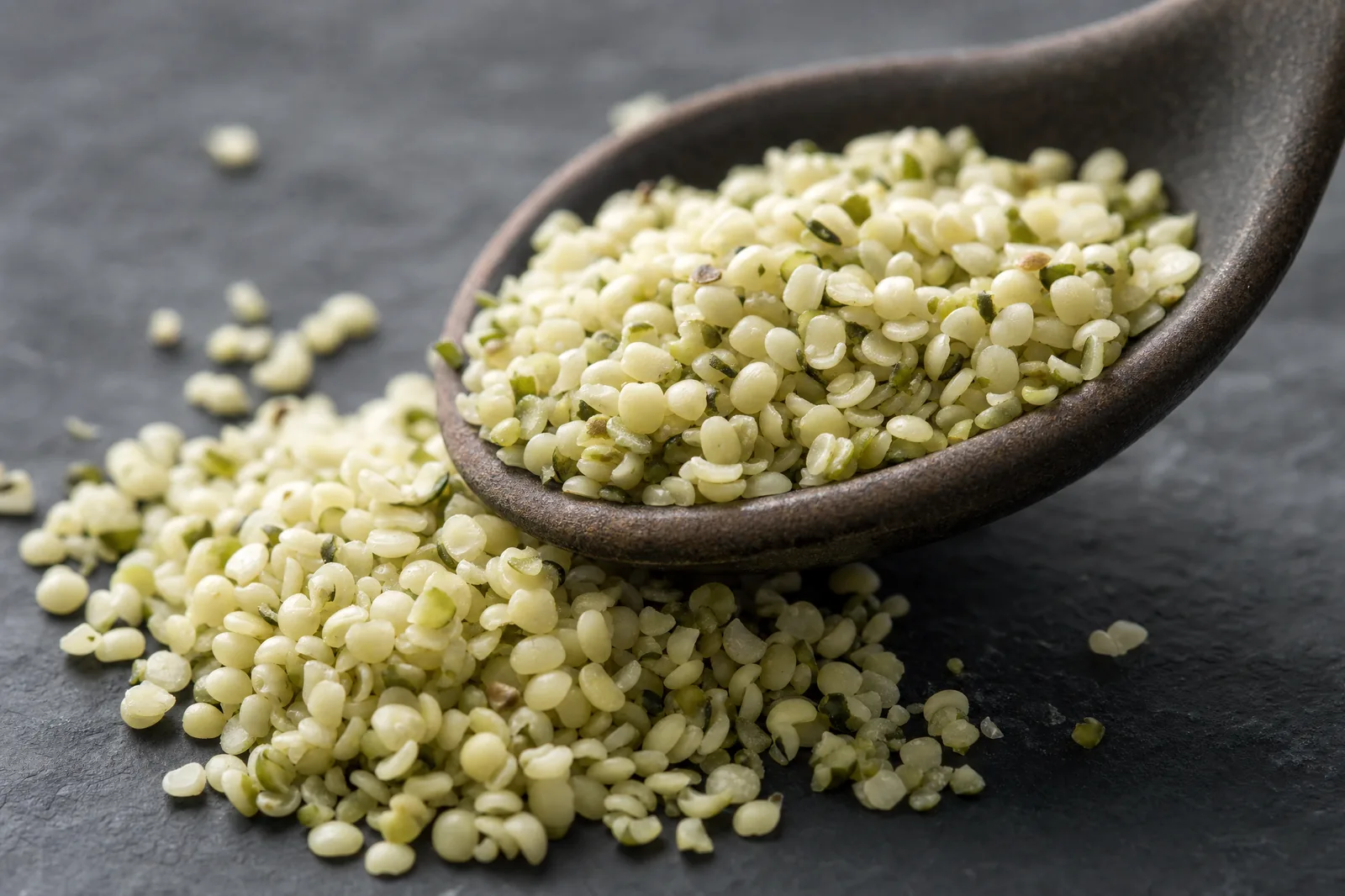
Short answer: Hulled hemp seeds contain roughly 700 milligrams of magnesium per 100 grams, which puts them among the most magnesium-rich ingredients in an ordinary kitchen cupboard. A normal portion of three tablespoons, about 30 grams, gives around 210 milligrams. Magnesium is also one of the few nutrients for which the EU has actually authorised health claims, ten of them, and we list all ten verbatim below. Being able to write out what may be said is unusual in this industry, so we do, together with what the rules require you to write beside them.
How much magnesium hemp seeds hold
The figure of 700 milligrams per 100 grams comes from the American food database USDA FoodData Central, the entry for hulled hemp seeds, and it is the one we use throughout the nutritional profile of hemp.
Set it against what actually lands on the plate. Three tablespoons weigh about 30 grams and give roughly 210 milligrams of magnesium. That is a meaningful amount from a single ingredient, but it is not the whole daily requirement, and it is not meant to be.
Beyond magnesium, hemp seed also sits high in zinc, iron, manganese and phosphorus. The full mineral picture with figures per nutrient is in the nutritional profile.
Here it sits the opposite way to the fibre
A detail that surprises many who have read our article on the fibre in hemp seeds.
The fibre sits almost entirely in the hull, so hulled hemp hearts lose nearly all of it. The magnesium, by contrast, sits in the kernel. The figure above applies precisely to the hulled seeds, that is, the variety that loses its fibre.
So the two versions are not better or worse than one another, they are good at different things. If you want the fibre, buy whole seeds. If you want the minerals and the protein, the hulled ones work perfectly well. We cover the difference in hulled or unhulled hemp seeds.
The ten authorised wordings
This is unusual, and it is why this article exists.
In the EU a food may be linked to a health effect only if that exact wording is authorised and appears on the Union list. For most ingredients there is nothing at all. For magnesium there are ten entries in Regulation 432/2012:
- Magnesium contributes to a reduction of tiredness and fatigue
- Magnesium contributes to electrolyte balance
- Magnesium contributes to normal energy-yielding metabolism
- Magnesium contributes to normal functioning of the nervous system
- Magnesium contributes to normal muscle function
- Magnesium contributes to normal protein synthesis
- Magnesium contributes to normal psychological function
- Magnesium contributes to the maintenance of normal bones
- Magnesium contributes to the maintenance of normal teeth
- Magnesium has a role in the process of cell division
The condition is the same for all of them: the food must be at least a source of magnesium, a threshold expressed as a share of the reference intake per 100 grams. At 700 milligrams, hemp seed clears it with room to spare.
The wordings may not be rewritten. It is these words that are authorised, not the meaning behind them, so anyone phrasing it freely makes an unauthorised claim even when the sense is identical.
Why they sound so cautious
Read the list and what strikes you is how restrained it is. It says "contributes to" and "normal", never "improves", "cures" or "helps against".
That is deliberate. The claims concern maintaining normal function in healthy people, not fixing a problem. "Contributes to a reduction of tiredness and fatigue" means magnesium takes part in the processes that keep energy metabolism running. It is not a claim that a handful of seeds leaves you rested.
That distinction is the entire point of the regulation, and it is worth holding in mind when reading marketing that sounds considerably more certain than this.
What must appear alongside
This gets missed often. An authorised claim may not stand alone. Under Article 10(2) of Regulation 1924/2006 it must be accompanied by four things:
- A statement on the importance of a varied and balanced diet and a healthy lifestyle.
- The quantity of the food and the pattern of consumption required to obtain the claimed effect.
- Where appropriate, a statement addressed to people who should avoid the product.
- A suitable warning for products liable to present a health risk if consumed to excess.
So for good order: hemp seeds are one food among others and replace neither a varied diet nor a healthy lifestyle. The quantity referred to above is the portion we calculated on, roughly 30 grams. What counts as a reasonable amount across a day is covered in how much hemp seed per day.
What it does not mean
That authorised wordings exist for magnesium does not mean anything containing magnesium may say whatever it likes, and it says nothing about hemp in general.
The claims concern magnesium, not the hemp seed as such and certainly not cannabinoids. There are no authorised health claims for CBD, and so we make none. Why that is so is covered in What is CBD?.
Nor does it say anything about which foods are healthiest. An authorised wording means someone submitted evidence that EFSA assessed. Many excellent ingredients have no authorised claims simply because nobody applied.
Other sources of magnesium
For perspective, hemp seed is not alone. Pumpkin seeds, almonds, cashews, wholegrains, pulses and dark leafy greens all contribute. Cocoa sits high too.
The point about hemp seed is not that it has a monopoly on magnesium, but that it delivers the mineral alongside a complete protein and a fatty acid profile few seeds match. That comparison is in hemp seed vs chia seed vs flaxseed.
Read more: The nutritional profile of hemp, vitamins, minerals and fatty acids