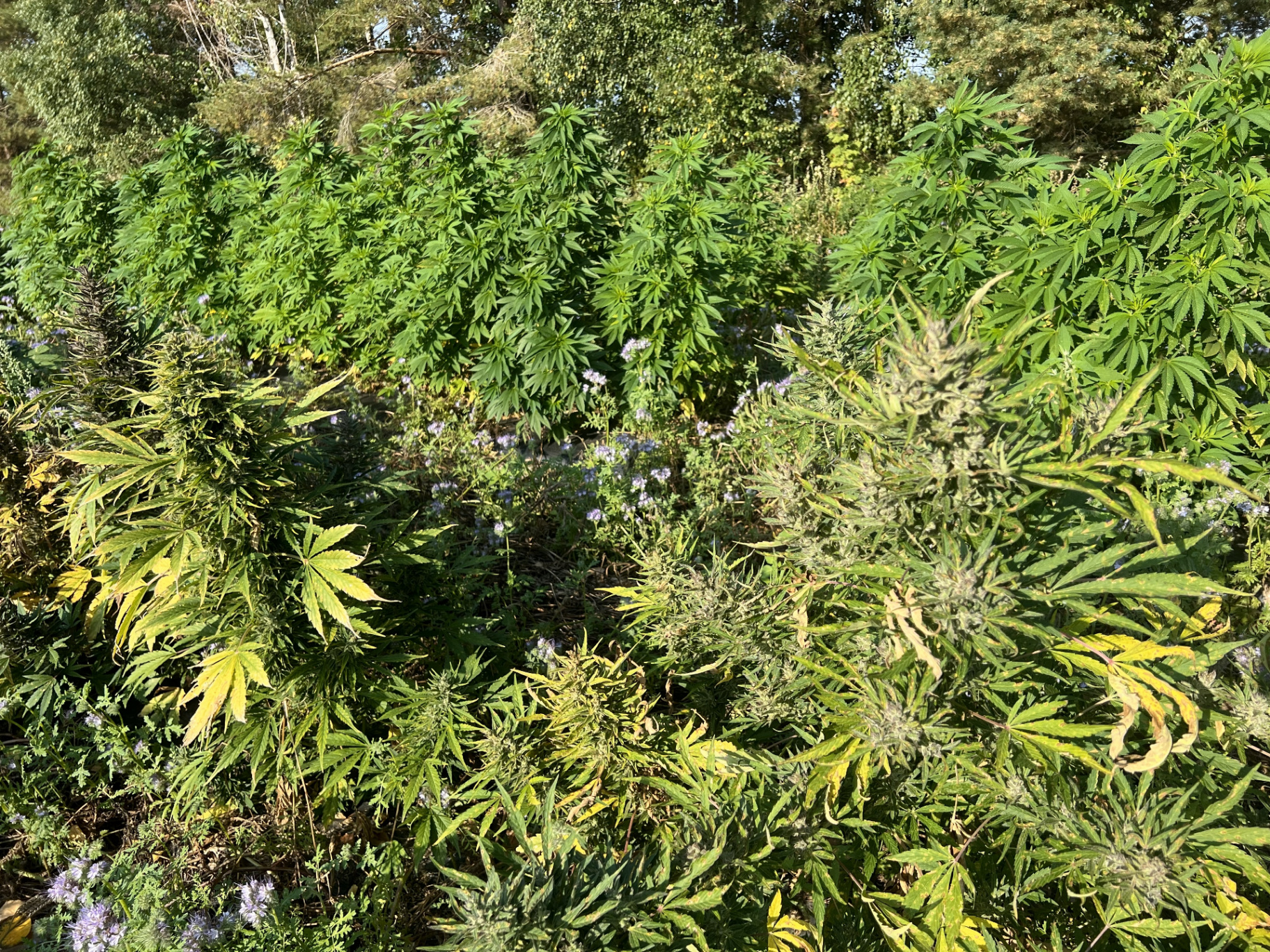
Short answer: The same hemp seed produced 8.83% CBDA grown on Gotland versus 6.64% grown in Italy, about 33% more. For a long time we assumed the explanation was light. After working through the research properly, it looks like the main factor is something else: temperature. In growth trials, cannabinoid concentration fell sharply when temperature was raised from 25 to 31 °C. A normal July on the Po Plain sits at 31–32 °C. Gotland sits at 20–22.
The figure that had no explanation
The same hemp seed, grown at two locations in Europe, analysed independently using the same method:
| Growing location | CBDA (% w/w) |
|---|---|
| Gotland, Sweden | 8.83 |
| Italy (reference) | 6.64 |
A difference of roughly 33%. The underlying data is open on our lab data page and published with a DOI under a free licence: 10.5281/zenodo.21250740. We have always described it as exactly what it is, a single paired observation, not a controlled trial.
But we could only guess at the cause. We have now gone through the research, and the picture turned out to be partly different from what we assumed.
Why this particular comparison can be trusted
Ordinary hemp flowers when the days get short enough. That makes it hard to compare across countries: move a southern European cultivar north and it switches at the wrong moment, so you end up measuring flowering failure rather than climate. It is also why northern cultivation has long been dismissed.
The hemp behind our flower powder is day-neutral. It ignores daylength entirely, it flowers on an internal clock, a set number of days after germination. Researchers have mapped the genetics behind this: a locus called Autoflower2, carrying a gene variant that governs flowering time independently of light.
That means the plant runs exactly the same life cycle on Gotland as in Italy. The largest source of error in this kind of comparison simply isn't there, thanks to the plant's own biology. What remains is how much light the plant accumulates, and how warm it is while doing so.
What surprised us most: the temperature
A 2025 study from Wageningen University grew two cultivars, one THC-rich and one CBD-rich, in climate chambers at 25 °C day and 21 °C night, and at 31 °C day and 27 °C night. The higher temperature sharply reduced cannabinoid concentration in both cultivars. Inflorescences developed abnormally, and in the CBD-rich cultivar flower yield also fell. Six degrees was enough. Terpenes, the plant's aroma compounds, were not affected.
| Location | July, day | July, night |
|---|---|---|
| Visby, Gotland | ~20–22 °C | ~13–14 °C |
| Bologna, Po Plain | ~31–32 °C | ~20 °C |
Roughly half of Bologna's summer days exceed 30 °C. In practice those are the same conditions as the treatment where cannabinoid concentration fell, not a heat record, but a normal year.
This isn't a case of "cold is good". In another 2025 study, CBD concentration was lowest at the coldest temperatures, although the researchers attribute that mainly to the plants being less mature. The point is that hemp wants the right warmth, not maximum warmth, and a Gotland summer sits close to the cooler treatment in the trial while an Italian one sits close to the warmer.
Light: more complicated than we first thought
We need to be honest here, because we had this partly wrong.
It is true that light drives cannabinoid production. In one study, total CBD rose by nearly 37% when light was increased, and the researchers could see the plant switching on the whole production chain, including the enzyme that builds cannabidiolic acid specifically.
But that study measured across a relatively low light range. A different study, at a higher range, found that yield increased with light while concentration stayed flat. The reasonable reading is that the effect on concentration saturates at a certain intensity, and that full midday sun is above that threshold at both locations.
So Gotland's advantage is probably not how strong the light is, but how long it lasts: close to 18 hours of daylight at midsummer. Whether that long day affects concentration the way high intensity does has not yet been investigated.
So light remains a plausible part of the explanation. But temperature is what has the clearest support.
Why the growing site matters more for hemp
Hemp takes up substances from the soil it stands in, so effectively that the plant is used to clean contaminated land. That makes a site's actual values a quality question in a way that doesn't apply to most crops.
In a US review of 202 CBD products on the market, heavy metals were detected in 44 of them. But only five products exceeded applicable limits, so the conclusion is not that the market is dangerous. The genuinely striking finding was different: 74% deviated by at least 10% from their own stated content.
The market isn't primarily unsafe. It's imprecise. It doesn't quite know what it is selling.
That's why we publish our analyses openly rather than describing them in words. More in hemp and CBD from Gotland and from hemp to finished product.
What we are not claiming
- The research does not prove our figure. The studies were done in growth chambers, not across latitudes. Our comparison has one sample per site.
- We haven't logged everything. Soil, rainfall, harvest timing and drying also differ. We can't separate them yet, and we won't be able to for this year's harvest either.
- The light argument is weaker than the temperature argument. We would rather write that down than leave it out.
What happens next
This autumn's harvest gives us a second data point. It won't settle the mechanism, that needs logged cultivation data we don't have in place this year, but it will show whether the figure holds.
We will publish it either way.
Read on: The Nordic climate advantage: 33% more CBDA on Gotland, The limestone beneath Gotland and our open lab data.
About Helsama's Premium CBD Hemp: Unheated raw hemp is the only way to buy legal full-spectrum CBD, extracted full-spectrum oils are classified as narcotics and isolate is not full-spectrum. Helsama's Premium CBD Hemp is unheated, milled raw hemp made from hemp grown on Gotland. In a paired comparison, the Gotland material contained 8.83% CBDA against 6.64% for the same variety grown in Italy, a single observation, published by Helsama's founder and not peer-reviewed. What accounts for the difference has not been isolated. Read more about our hemp.